Tamper-Evident Packaging: Induction Foil Liners vs Shrink Bands and Breakaway Closures
Compare foil innerseals, shrink bands and breakaway closures by visible entry evidence and leak protection, with the scope of 21 CFR 211.132.
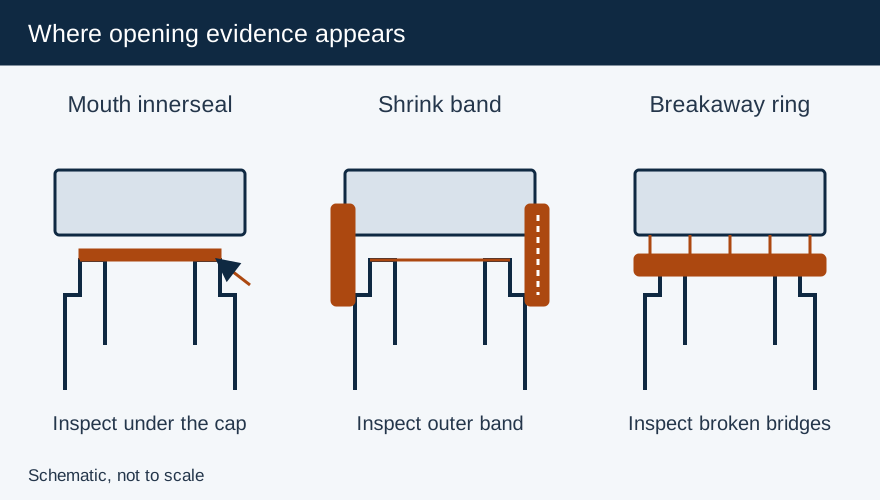
Tamper evidence and leak protection are separate package functions. A neck band can show that a closure was opened while leaving liquid sealing to the cap and liner. An induction innerseal bonds at the mouth, but its finished design and application must still provide the required opening evidence and package performance.
| Feature | Where evidence appears | Contribution to liquid sealing | Design/qualification focus |
|---|---|---|---|
| Induction mouth innerseal | Beneath the removed cap | Bonded membrane across the rim | Continuous bond, visible breach and removal/reapplication resistance |
| Heat-shrink neck band | Outside cap/neck junction | Main liquid seal remains elsewhere in the closure system | Tight fit, visible damage on opening and identifying characteristic |
| Breakaway closure | Frangible cap or pilfer feature | Depends on the cap/liner sealing design | Irreversible visible break and correct application |
| Combined inner and outer features | Mouth plus external closure | Determined by the innerseal and complete package | Both features work through distribution and opening |
| Removable pressure-sensitive foam | Mouth under cap | Supplier/product-dependent; commonly intended for dry goods | Conventional removable/reapplicable foam is unsuitable as the OTC tamper-evident feature described by FDA |
Apply 21 CFR 211.132 to the products it covers
The rule applies to retail OTC human drugs accessible to the public while held for sale, with stated exclusions for dermatological, dentifrice, insulin and lozenge products. It requires visible evidence of entry, a distinctive package or identifying feature, and appropriate labeling. The current rule also requires covered two-piece hard gelatin capsules to be sealed using acceptable tamper-evident technology in addition to the package feature.
Its labeling provisions require the statement to identify the features, remain visible if they are breached or missing, and reference an identifying characteristic where used. The rule includes specific labeling exceptions. Review the actual product and current section with the responsible regulatory team; food, supplements and industrial chemicals have their own applicable requirements.
Evaluate barrier design rather than technology name
FDA CPG Sec. 450.500 describes packaging approaches capable of providing tamper evidence. It also explains that selecting a listed technology alone does not establish compliance. For a mouth seal, opening must leave visible evidence and reapplication must not restore the original appearance. For a shrink band, removal must damage the band rather than allow it to slide off intact. Breakable caps must visibly change when opened.
The CPG identifies pressure-sensitive polystyrene foam seals that can be removed and reapplied in their original condition as ineffective tamper-resistant features. Evaluate the finished design and its labeling, including whether the opening evidence survives normal distribution. Clean-peel behavior by itself neither proves nor rules out tamper evidence: inspect the seal’s complete breach and reapplication behavior.
Test liquid leakage independently
An external band does not form a bonded seal across the bottle mouth. Its presence cannot demonstrate that the underlying cap/liner system contains liquid. An induction membrane provides that mouth barrier when the liner is compatible and the seal is properly formed, but damage, product interaction or an incomplete bond can still defeat it.
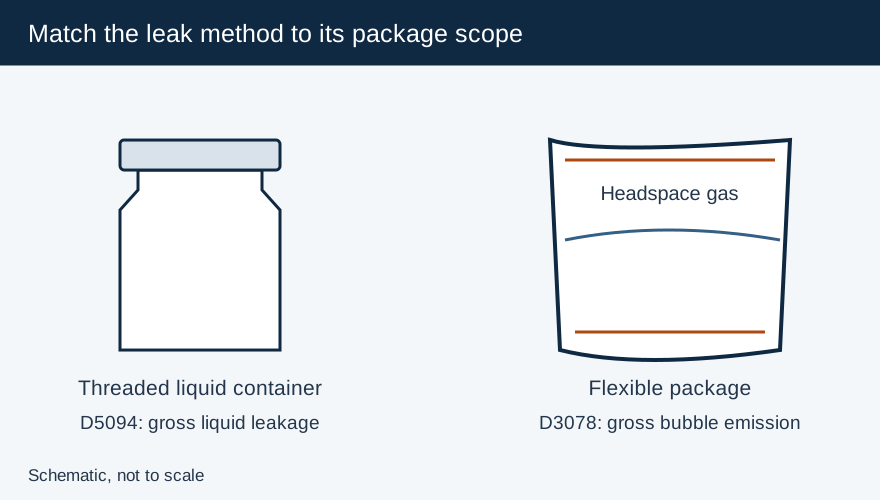
Define transport orientation, pressure, temperature and handling exposure for the distribution route, then qualify the complete filled package. ASTM D5094/D5094M covers gross leakage from rigid or semi-rigid liquid containers up to 4 L with threaded or lug-style closures. Its scope cautions that these methods may be unsuitable for hazardous-material transport packages; qualify those under the applicable transport requirements. Use the appropriate integrity method for the required leakage sensitivity and package configuration. Check retained performance after relevant exposure rather than relying only on an upright bench sample.
Select inner and outer features for the inspection moment
A shopper can see a neck band or breakaway ring before removing the cap. An innerseal is normally inspected after the cap is opened. Combining features can provide evidence at both stages, but the combination adds application and inspection work.
Specify which feature the consumer should inspect and ensure the labeling remains with the package if that feature is missing. In the line trial, check band fit, opening damage, cap/pilfer application and innerseal bonding as separate observations. Include any heat exposure from band shrinking in the package qualification and agree the station sequence with the equipment suppliers.
Connect the package specification to line verification
Keep the approved artwork, identifying characteristic, label statement and material grades with the package record. Define how missing, damaged or incorrectly applied features are detected and rejected. Liner-presence detection does not demonstrate complete adhesion, and a readable label does not demonstrate that the physical barrier works.
Use the line integration guide to specify transfer and rejection, and inspect opening evidence on representative finished packs. Maintain separate acceptance records for tamper evidence, leakage and consumer opening so one successful check does not conceal a failure in another function.
Frequently Asked Questions
Does a shrink band make a bottle leak-tight?
The band surrounds the closure externally. Liquid containment depends on the cap, liner, bottle and any bonded mouth seal, and must be qualified on the filled package.
Does every foil liner meet OTC tamper-evidence requirements?
The finished package must provide the required visible evidence and distinctive feature, with appropriate labeling. Foil material alone does not establish compliance.
Primary Sources & Referenced Standards
- 21 CFR § 211.132 — Tamper-evident packaging requirements for over-the-counter (OTC) human drug products
- FDA CPG Sec. 450.500 — Tamper-Resistant Packaging Requirements for Certain Over-the-Counter Human Drug Products
- Selig Group — Container Sealing Portfolio (Lift 'n' Peel, CoreSeal, DeltaSeal, FoilSeal, Top Tab, Uni-Gard, OenoSeal, Vented)
- Enercon: Getting Started with Induction Cap Sealing
- ASTM D5094/D5094M-24: Gross leakage of liquid containers with threaded or lug closures
More about Seal Integrity Testing
Leak testing, peel and opening checks, online inspection and tamper-evident packaging requirements for the relevant product.