
Choose the liner by its job
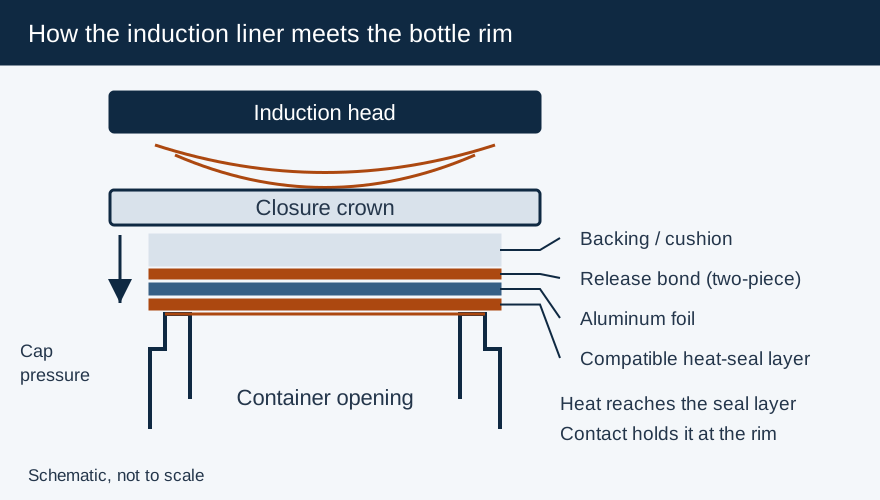
Specify initial leakage protection, opening evidence, removal behavior and resealing after first use separately. An induction liner bonds a foil membrane at the mouth. A pressure-sensitive liner uses adhesive under cap pressure. A primary foam liner seals through compression in the closure assembly.
| Construction | Function | Selection evidence |
|---|---|---|
| One-piece induction | Innerseal remains together at the mouth | Material match and intended opening behavior |
| Two-piece induction | Innerseal plus backing retained in cap | Release, cap retention and resealing qualification |
| Pressure-sensitive | Adhesive contact without induction heating | Supplier-approved product use; Selig recommends dry products |
| Primary PE foam/pulp | Compression seal between cap and container | Closure fit and repeated-use leakage checks |
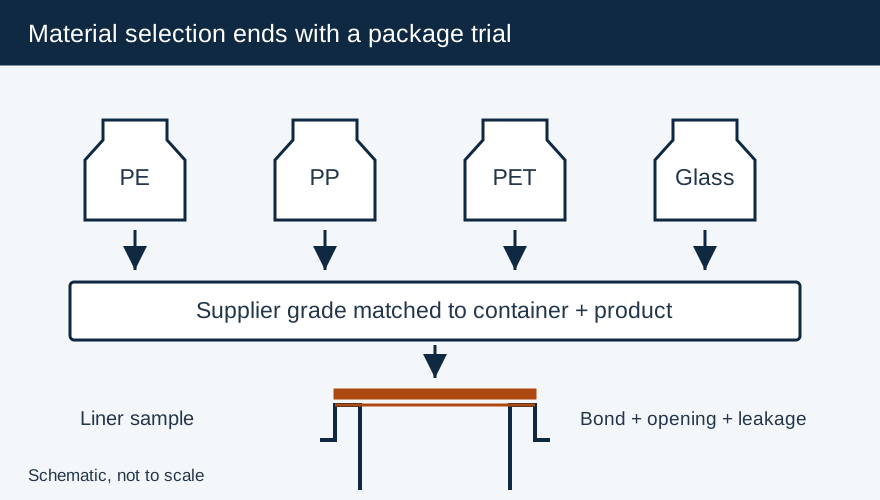
Match HDPE, PP, PET and glass at grade level
Selig identifies container material as a primary heat-seal selection input. Request a liner grade approved for the actual HDPE or other PE, PP, PET or glass finish and the formulation. Similar-looking foil can carry different seal layers; select the supplier's material code and compatibility data rather than inferring chemistry from appearance.
For glass, include finish and surface conditions in the trial. For aggressive contents, discuss a protective barrier layer. For gas generation or pressure equalization, assess a vented system and test it for the intended liquid and gas behavior. Read the liner selection guide for the full specification record.
Separate backing release from heat-seal adhesion
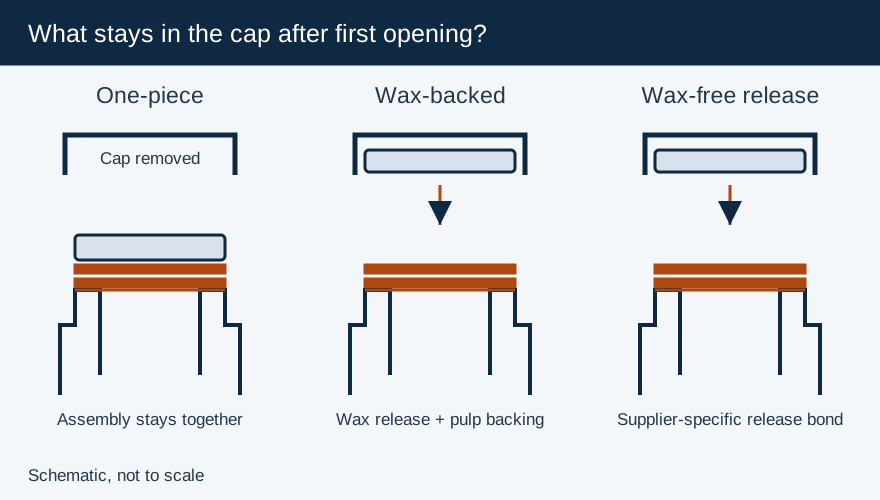
In a conventional wax-backed two-piece liner, induction heat supports both sealing and release from the pulp backing. Selig's DeltaSeal uses temporary polymer lamination to pulp reseal board instead of wax. Its wider temperature stability must still be matched to the specific fill and storage conditions.
Backing retention can use the cap's retention feature or an approved gluing method: Selig describes both options for Safe-Gard. Verify feeding, liner retention and post-opening performance with the complete cap. The construction comparison follows the layers through first opening.
Connect closure choice to the line
A cork stopper seals against the bottle bore; an ROPP wine screw cap seats a liner against the top finish and forms its shell around external threads. Selig's OenoSeal family uses customized EPE liners with oxygen barriers for ROPP wine closures. The bottling-process comparison covers glass drawings, closing heads, headspace controls and opening tests.
For weak induction bonds, inspect cap pressure, land condition, alignment, exposure and material identity before changing power. Use the five-factor adhesion guide and retain both successful and failed samples with their lots.
For retail OTC human drugs covered by 21 CFR 211.132, FDA identifies conventional removable/reapplicable pressure-sensitive polystyrene foam mouth seals as ineffective tamper-resistant features. Qualify the actual barrier and labeling using the tamper-evidence comparison.
Primary references
- Selig Group — Container Sealing Portfolio (Lift 'n' Peel, CoreSeal, DeltaSeal, FoilSeal, Top Tab, Uni-Gard, OenoSeal, Vented)
- Selig Group — Top Tab™ & One-Piece vs Two-Piece Induction Liner Engineering
- Enercon: Getting Started with Induction Cap Sealing
- FDA CPG Sec. 450.500 — Tamper-Resistant Packaging Requirements for Certain Over-the-Counter Human Drug Products