
Induction Seal Liners: One-Piece vs Two-Piece Wax-Backed Construction and Container Matching
Compare one-piece, wax-backed two-piece and wax-free release liners, including layer function, backing retention and container compatibility.
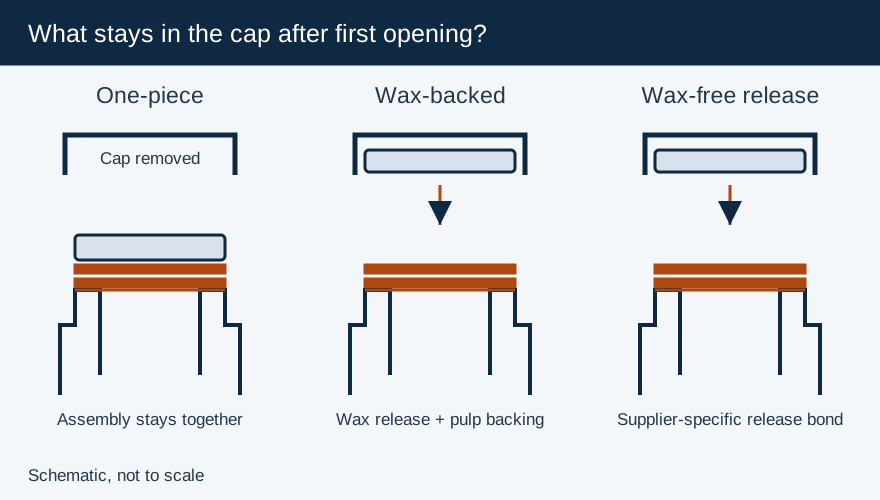
Choose one-piece or two-piece induction liners according to what the package must do after first opening. Both can bond a foil membrane to the bottle mouth; a two-piece construction also leaves a backing in the cap. Selecting the wrong construction can create a satisfactory first seal but an unsuitable reclosed package.
| Construction | Functional layers | Result when the cap is removed | Selection check |
|---|---|---|---|
| One-piece | Backing/support, foil and compatible heat-seal layer | The innerseal stays together at the mouth | Opening method and any separate resealing feature |
| Two-piece wax-backed | Pulp backing, wax bond, foil and heat-seal layer | Foil stays at the mouth; backing remains in cap | Wax release, backing retention and reclosed performance |
| Two-piece wax-free release | Backing, temporary release bond, foil and heat-seal layer | Innerseal and cap backing separate | Supplier’s release mechanism and temperature suitability |
This is a functional comparison. Converter grades can add support, protective or barrier layers to suit the formulation and removal requirements.
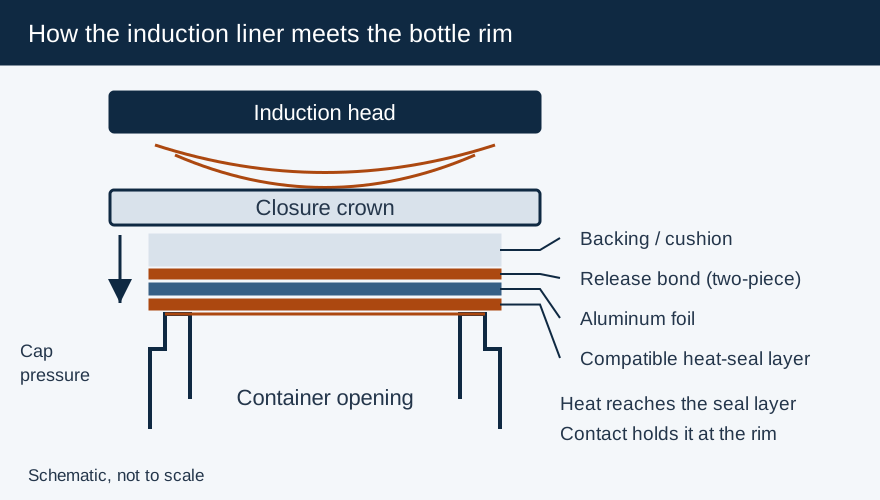
How the wax-backed layer stack separates
Enercon’s Getting Started with Induction Cap Sealing illustrates backing, wax bond, foil and heat-seal layers. During sealing, the foil receives induction energy. Heat activates the bottle-facing layer and allows the wax-backed assembly to separate. In the conventional pulpboard construction, the molten wax is absorbed into the board so the backing can remain with the closure.
The two outcomes must both be checked: a continuous bond at the bottle rim and the intended release between backing and innerseal. Inspect after the cooling period specified for the package. Opening while the bond or release system is still changing can produce a misleading result. When there is incomplete separation, compare the material lot and operating window before increasing heat; excessive exposure can discolor backing or distort foam.
Wax-free does not mean one universal hot-fill liner
Selig describes DeltaSeal as heat-seal-coated aluminum foil temporarily polymer-laminated to pulp reseal board. Removing wax gives that construction stability over a wider temperature range. Specify the actual fill, capping and storage conditions when requesting the appropriate grade.
The allowable temperature comes from the liner and closure system’s specification. A change from wax-backed to wax-free material can also change release behavior and required sealing exposure. Establish the operating window again on the proposed package, then inspect both the first seal and the cap backing after opening.
Backing retention depends on the closure design
A retention bead is one option, but it is not the only way to hold a two-piece liner. Selig explicitly states that Safe-Gard two-piece liners may be glued into a cap or inserted behind a retention feature. Obtain the approved cap/liner assembly drawing and lining method.
Check retention through cap feeding and handling, before sealing as well as after opening. Confirm that the assembled liner thickness permits correct closure engagement and that the cap seats without bottoming out on the bottle shoulder. A supplier-approved change in backing thickness still needs a capping and opening trial on the actual container.
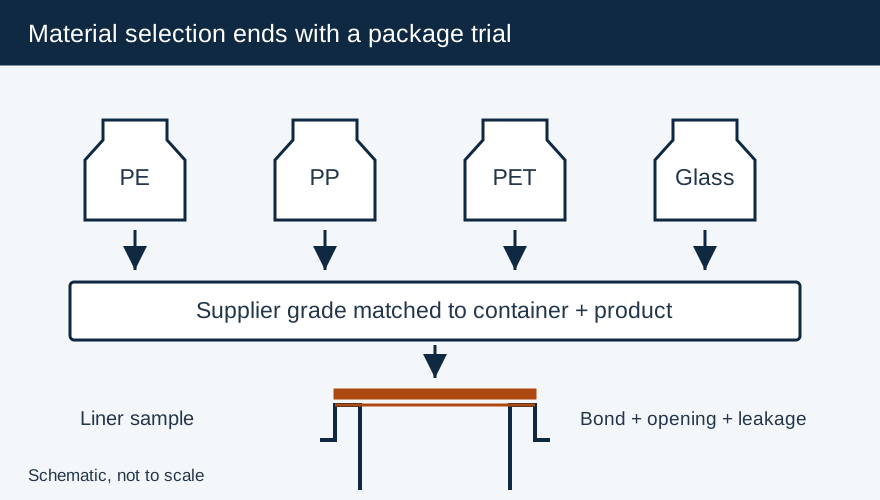
Match the heat-seal layer to PE, PP, PET or glass
Piece count describes separation; it does not establish substrate compatibility. Selig’s container guidance makes the container material a primary selection input. Ask for a grade approved for the actual PE, PP, PET or glass finish and the contents. Glass bonding in particular should follow the liner supplier’s finish and surface requirements.
Check resealing and consumer opening in the same trial
For a two-piece liner, remove the cap and inspect whether the backing stays where intended without pulling the foil off the rim. Open the innerseal using the designed method, then reclose and test repeated-use performance under the conditions relevant to the product. Keep the cap, container and liner lot identities with the results.
For a one-piece seal, verify how the consumer grips or pierces the membrane and whether the package has a separate resealing mechanism. Selig’s Top Tab is a useful example of why a visible tab alone does not reveal piece count: it is a two-piece system, with pulp retained in the cap and a tabbed seal retained at the bottle. The liner selection guide compares these opening and barrier decisions; the adhesion guide covers failed bonds.
Frequently Asked Questions
Does a two-piece liner always require a retention bead?
Use the supplier-approved assembly method. Selig describes Safe-Gard two-piece liners that can be glued into the cap or inserted behind a retention feature.
Can wax-free liners be used for hot filling?
Select a grade qualified for the actual fill, capping and storage temperatures. Wax-free construction alone does not set the package’s allowable temperature.
Primary Sources & Referenced Standards
- Enercon: Getting Started with Induction Cap Sealing
- Selig Group — Container Sealing Portfolio (Lift 'n' Peel, CoreSeal, DeltaSeal, FoilSeal, Top Tab, Uni-Gard, OenoSeal, Vented)
- Selig Group — Top Tab™ & One-Piece vs Two-Piece Induction Liner Engineering
- Tekni-Plex — Securing Your Induction Heat Seal Liner Supply Chain & Liner Qualification
More about Cap & Liner Selection
One-piece and two-piece wax-backed or polymer-bonded foil innerseals, container resin compatibility (PE, PP, PET, PVC, glass), and ROPP vs. cork closures.
Related Articles
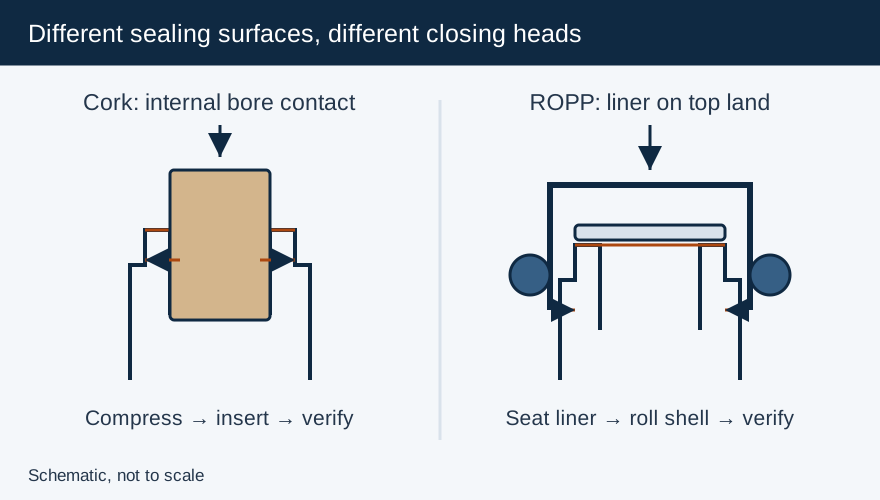
Cork vs Screw Cap: What Changes in the Bottling and Closing Process?
Compare still-wine cork insertion and ROPP screw capping by bottle finish, closing action, headspace control, liner and release tests.
Induction Foil Seal Adhesion Failure and Overheating Troubleshooting Guide
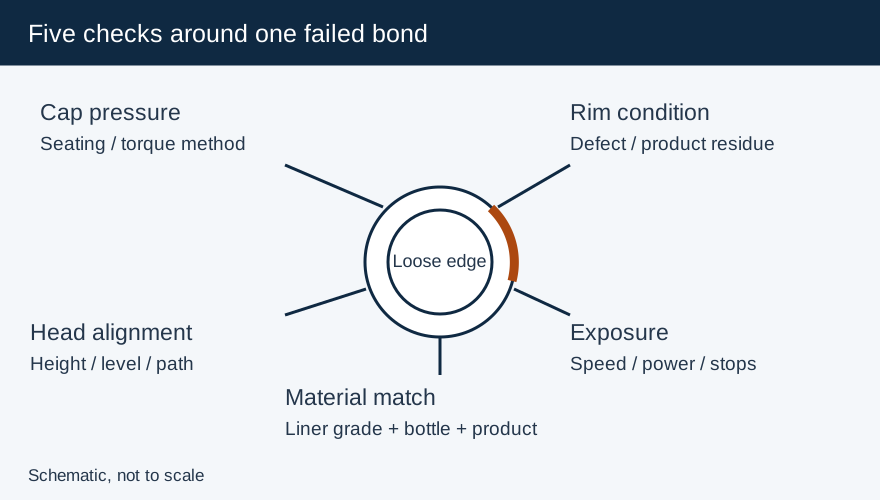
Use five checks—cap pressure, rim condition, coil alignment, conveyor exposure and material match—to isolate foil adhesion failure and overheating.
Induction Sealing Liners: Matching Bottles, Caps and Contents
Select foil liners by container material, opening behavior, product exposure and resealing needs; compare pressure-sensitive and compression liners.