
Cork vs Screw Cap: What Changes in the Bottling and Closing Process?
Compare still-wine cork insertion and ROPP screw capping by bottle finish, closing action, headspace control, liner and release tests.
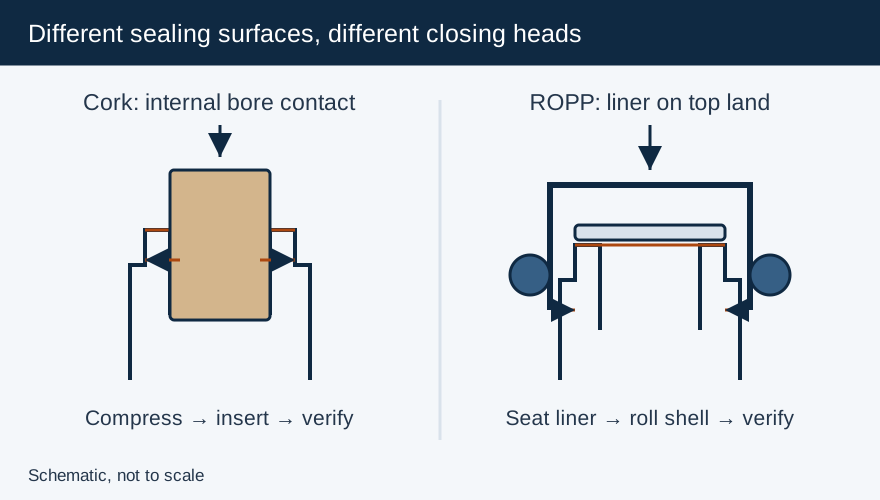
Changing from a cork stopper to an aluminum ROPP screw cap changes the bottle finish, closing head and quality checks. A cork seals against the internal neck, while the screw-cap liner is seated against the top finish and the shell is formed around the external thread. Plan the conversion as a package-and-line change; incompatible glass and closing tooling can damage the package or leave it leaking.
| Bottling decision | Cork stopper for still wine | ROPP screw cap |
|---|---|---|
| Sealing surface | Internal bottle bore in contact with the stopper | Liner against the bottle’s top sealing surface |
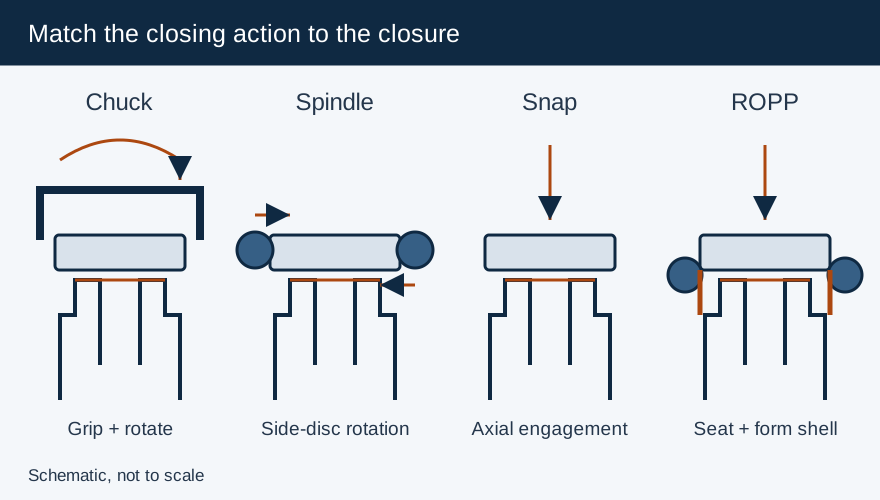
| Closing action | Compress and insert the selected stopper | Apply top load and roll the shell around a matching finish |
| Package specification | Stopper grade/dimensions and internal neck drawing | Cap shell, liner and matching external finish drawing |
| Headspace control | Fill height and corking vacuum appropriate to the package | Fill condition and oxygen-management process qualified for the closure |
| Mechanical QC | Insertion, stopper damage, extraction and pressure checks | Liner impression, thread/pilfer formation and opening torque |
The comparison concerns bottling and closure verification. Match the stopper or screw-cap liner to the wine’s storage and oxygen-management requirements with the closure supplier.
Specify the glass finish before choosing change parts
Diam’s Still Wine Closure and Bottling: Good Practices covers bottle-neck characteristics, compression, insertion and vacuum control. For corking, inspect the bore and select the stopper with the supplier for the actual bottle. Verify the corker jaws, alignment and insertion conditions rather than transferring a nominal stopper size to a new bottle drawing.
For an ROPP package, obtain the matched bottle and cap drawings, pressure-block profile and roller tooling. The ROPP technical guide describes forming the metal closure to the bottle finish. A thread that appears to fit is insufficient: the top surface, thread profile and pilfer-retention geometry are all part of the package.
Keep corking pressure and oxygen management under control
Cork insertion changes the occupied neck volume. Diam explains the role of vacuum before insertion and checking the resulting pressure after closure. It also distinguishes inerting the headspace from establishing the corking vacuum. Set and verify these operations with the intended bottle, fill height, wine and stopper.
On an ROPP conversion, review the fill and headspace arrangement with the bottling supplier rather than copying the corking recipe. Selig’s OenoSeal description identifies customized EPE wine liners with tin or saran oxygen barriers. Specify the liner and package oxygen target together; select the actual grade using supplier data and product qualification.
Read ROPP setup values with their exact scope
Chandler’s October 2020 Screwcap Application Settings sheet is for 0.23 mm gauge 8011-alloy 30 × 60 mm screwcaps on a BVS EN 16293 finish. The following values retain that scope and are supplier starting guidance for dry glass:
| Parameter in the Chandler sheet | Published guidance |
|---|---|
| Capping-head pressure load | In the vicinity of 150–180 kg, as expressed in the sheet |
| Pressure-block redraw depth | 1.5–1.7 mm |
| Initial slip torque | Usually 9–20 lbf·in; may reach 25 lbf·in |
| Bridge-break torque | 8–20 lbf·in, generally 12–18 lbf·in; deviations can be higher |
Use the current cap supplier’s settings for the cap batch and head. The sheet itself calls for adjustment to the individual application. Keep slip and bridge-break results separate; combining them into one universal removal-torque target hides distinct closure behavior.
Verify the closing operation, then the package
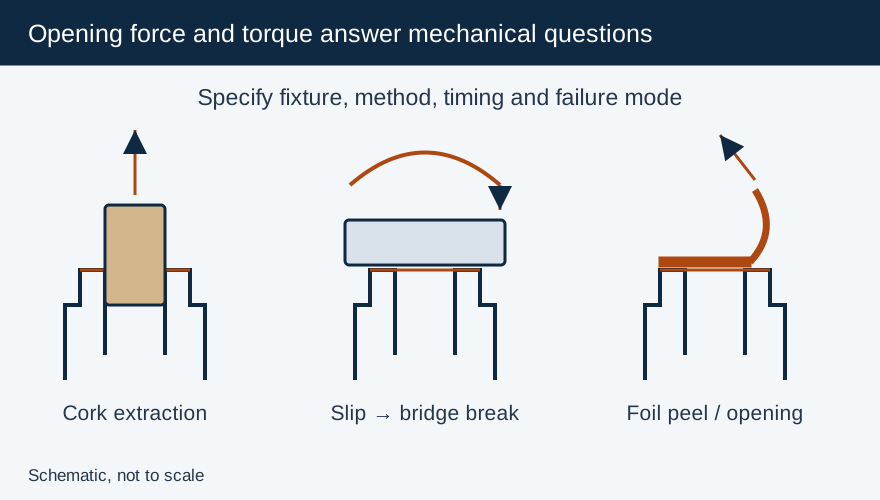
Mecmesin’s winery closure-testing guidance explains the phases of opening an ROPP cap and the use of torque testing to characterize them. Inspect formed threads, pilfer bridges and liner seating alongside that measurement. For corks, examine insertion and stopper damage and use the supplier’s extraction and pressure checks.
Run the conversion trial from filling through the final transfer. Include the approved sampling points, material lots and closing-head identity in the record. Test package leakage and retained performance under the intended storage and handling conditions; closure-integrity testing must be selected for the finished package and the question being asked.
The release package should contain the glass and closure drawings, change parts, head settings, headspace controls and measured acceptance criteria. This gives maintenance and quality teams a concrete basis for checking the conversion without treating a corker setting, ROPP load or liner grade as interchangeable.
Frequently Asked Questions
Can a cork and ROPP cap use the same bottle finish?
Use the bottle drawing specified for the closure. Corking depends on the internal bore, while ROPP uses a matching top land, external thread and pilfer-retention geometry.
What is the difference between ROPP slip and bridge-break torque?
Slip torque describes initial release of the applied closure; bridge-break torque describes severing the pilfer bridges. Record the phases separately using the supplier’s test procedure.
Primary Sources & Referenced Standards
- Still Wine Closure and Bottling: Good Practices
- ROPP Capping Technical Guide — Thread Rollers, Top Block Pressure & Pilfer Proofing
- Chandler / Vcap — ROPP 30x60 Capping Head Settings & Torque Specification Sheet (EN 16293 BVS Finish)
- Mecmesin — ROPP Screw Cap Closure Quality & Bridge Break Torque Testing
- Selig Group — Container Sealing Portfolio (Lift 'n' Peel, CoreSeal, DeltaSeal, FoilSeal, Top Tab, Uni-Gard, OenoSeal, Vented)
More about Cap & Liner Selection
One-piece and two-piece wax-backed or polymer-bonded foil innerseals, container resin compatibility (PE, PP, PET, PVC, glass), and ROPP vs. cork closures.
Related Articles
Induction Foil Seal Adhesion Failure and Overheating Troubleshooting Guide
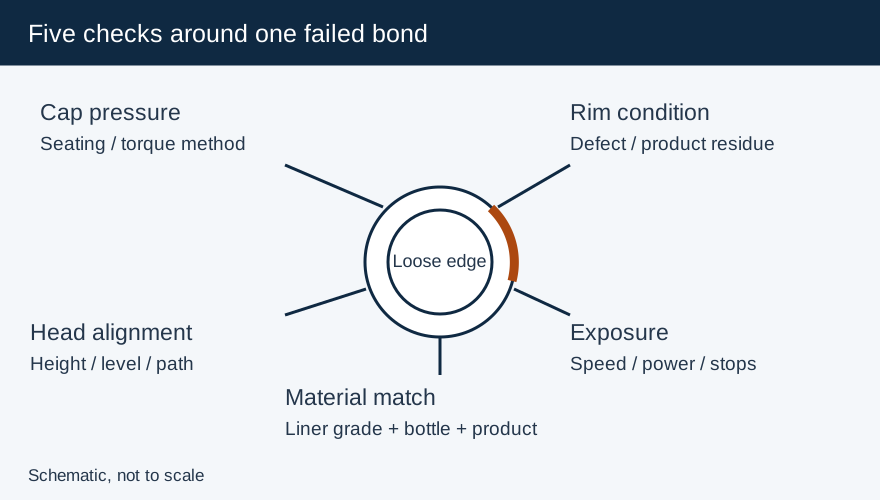
Use five checks—cap pressure, rim condition, coil alignment, conveyor exposure and material match—to isolate foil adhesion failure and overheating.
Induction Seal Liners: One-Piece vs Two-Piece Wax-Backed Construction and Container Matching
Compare one-piece, wax-backed two-piece and wax-free release liners, including layer function, backing retention and container compatibility.
Induction Sealing Liners: Matching Bottles, Caps and Contents
Select foil liners by container material, opening behavior, product exposure and resealing needs; compare pressure-sensitive and compression liners.