
Induction Foil Seal Adhesion Failure and Overheating Troubleshooting Guide
Use five checks—cap pressure, rim condition, coil alignment, conveyor exposure and material match—to isolate foil adhesion failure and overheating.
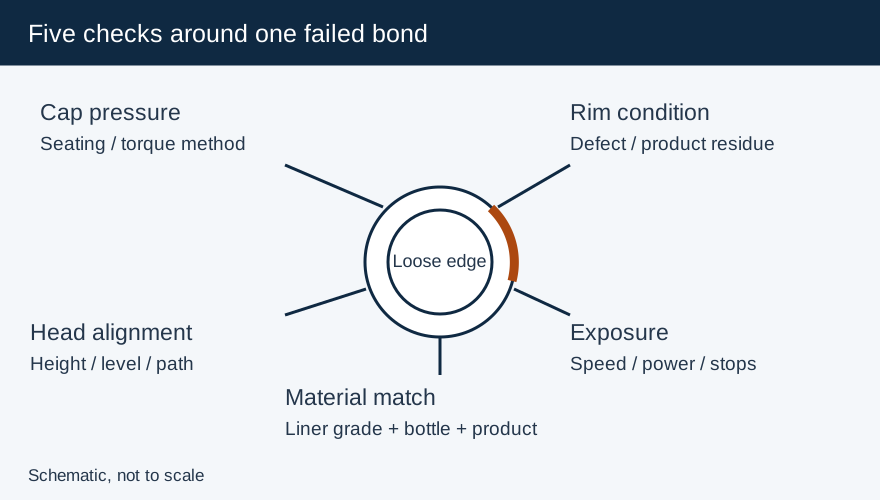
Diagnose a weak foil bond and an overheated liner as related process evidence, not as instructions to keep adding heat. Uneven contact can leave one edge loose while another discolors. Work through cap pressure, sealing land, head alignment, conveyor exposure and material compatibility, keeping the failed sample oriented to its bottle and line direction.
| Check | Evidence to collect | Corrective direction |
|---|---|---|
| Cap pressure and seating | Cap tilt, thread engagement, consistent torque method | Restore approved capping and closure fit |
| Bottle sealing land | Ridge, saddle, damage or product on the rim | Correct container or filling cause |
| Coil and package alignment | Head reference, level, centered cap path | Restore the installed head’s setup |
| Exposure | Actual belt speed, power and stop history | Restore motion and qualify energy inside the operating window |
| Material match | Liner grade, orientation, container material and product | Confirm the supplier-approved combination |
Cap pressure: prove that the liner contacts the rim
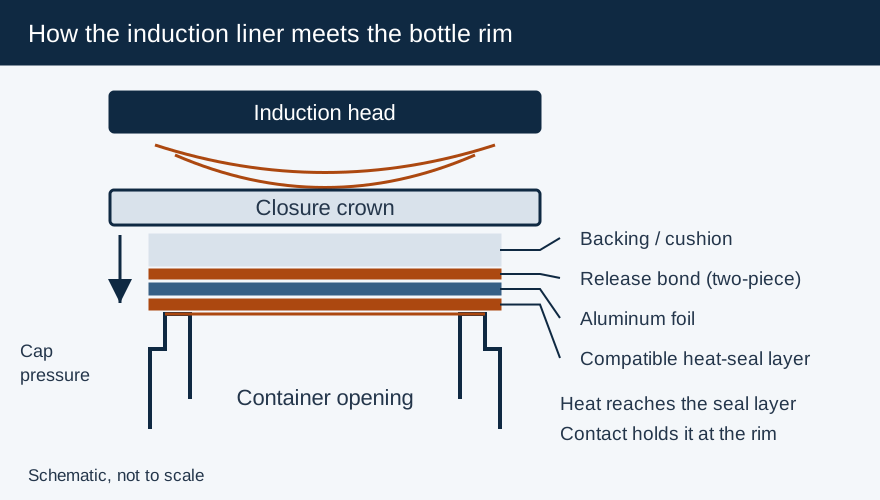
Enercon’s sealing guide identifies insufficient application torque as a major cause of poor seals. Check for a crooked cap, cross-threading or a skirt that reaches the bottle shoulder before the liner seats. Compare capper heads and compare packages before and after the transfer to the induction station.
A measured opening torque is useful only with a defined test procedure and timing. It does not directly show pressure at every point on the rim. Combine torque results with seating inspection and the failed bond’s location. Restore the approved capper setup before using the sealer to compensate for a mechanical problem.
Sealing land: separate defects from contamination
Inspect the full top land, including molding transitions and any location corresponding to the loose section of foil. Enercon lists saddles and ridges in the land as material-related causes of partial seals. Reject or hold containers outside the agreed finish specification; a thicker liner is a package-design change requiring qualification.
Compare rim condition after filling with unused containers from the same lot. Product wetting, powder and residues should be investigated through the filling and handling process. Use only an approved cleaning method for diagnostic samples, and keep those samples identifiable. A clean comparison can help identify a contamination contribution without authorizing a new production cleaning step.
Alignment: inspect the whole path under the head
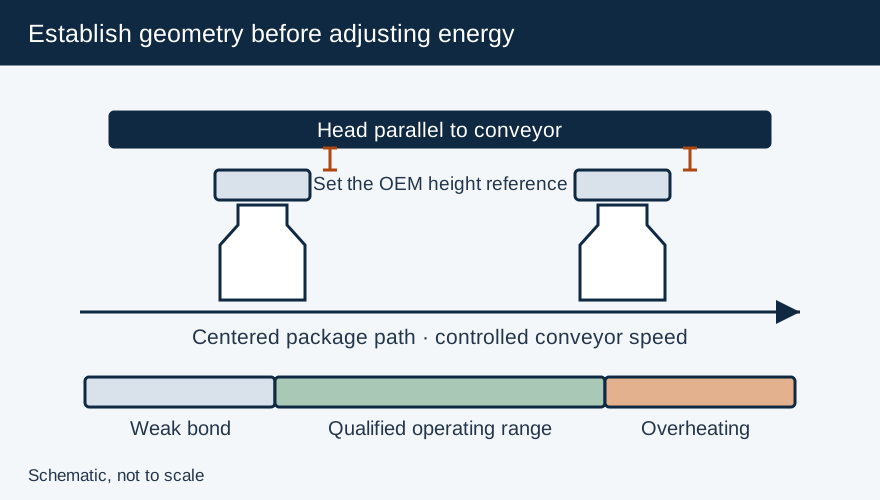
Check parallelism, centering and the height reference at the actual package position. Enercon gives a 1/8 inch cap clearance for its illustrated conventional setup and a liner-height indicator for deep-tunnel heads. The installed head’s instructions determine the correct reference.
If a failure repeats on the same side of the conveyor across different bottles, inspect the field geometry and guides. If it follows a particular bottle feature or cavity, inspect the land and closure fit. These comparisons guide the next trial; verify them with changed orientation or conforming samples under the supplier’s approved procedure.
Exposure: investigate overheating before restoring production
Enercon describes wrinkles, odor, backing discoloration and foam deformation as overheating signs, with excessive output or low line speed among the causes. Check actual motion and the event history. Hold packages exposed during a stall or interruption for evaluation.
A stopped bottle beneath an active induction head can overheat, with a particular fire risk for combustible contents. Restore and verify the line’s shutdown, emergency-stop and feed-control functions with the qualified integrator before production resumes. Additional detectors support those protective functions.
Once the mechanical setup is correct, use fresh samples to re-establish the acceptable operating window. A successful seal must meet the required bond, opening and integrity checks after the specified cooling and conditioning.
Material match: compare exact grades, not visual similarity
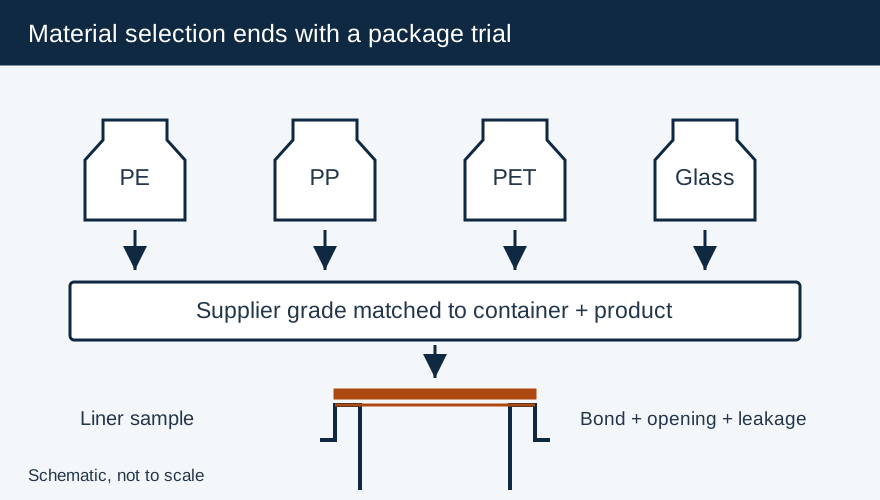
Selig identifies container material and product characteristics as key liner-selection inputs. Confirm the liner grade is intended for the actual PE, PP, PET or glass finish and formulation. Check for an unrecorded supplier, thickness or backing change.
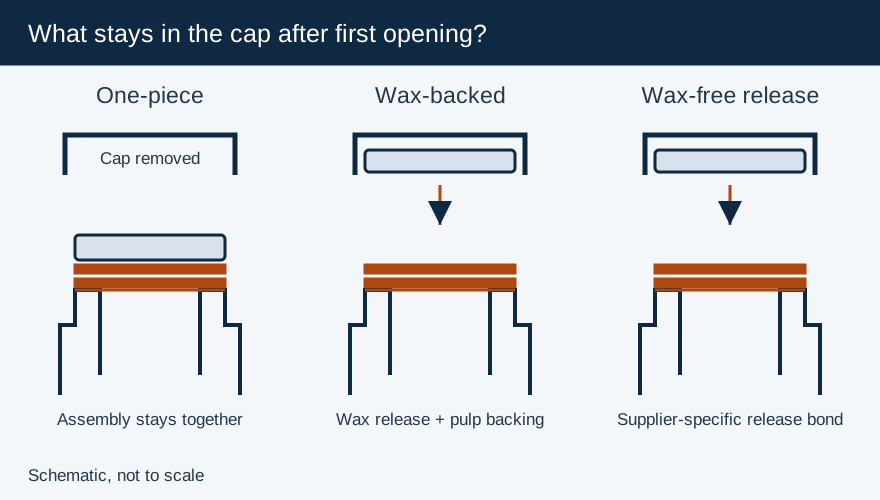
A clean peel can be intentional, while an unintended release may indicate inadequate energy, contamination or incompatible material. Inspect the requested removal behavior against a qualified reference. For two-piece liners, distinguish a backing-release problem from an unbonded innerseal.
Record the observed defect, isolated variable, changed setting and verification result. Keep the old and new samples with their material lots. Update the approved recipe only after representative packages pass the required checks, and use the broader troubleshooting sequence when machine alarms or multiple defects complicate the investigation.
Primary Sources & Referenced Standards
- Enercon: Getting Started with Induction Cap Sealing
- Troubleshooting Induction Seals: Container & Liner Material
- Inconsistent Application Torque Equals Inconsistent Seals - Induction Cap Sealing
- Selig Group — Container Sealing Portfolio (Lift 'n' Peel, CoreSeal, DeltaSeal, FoilSeal, Top Tab, Uni-Gard, OenoSeal, Vented)
- Safety Flammable Products - Enercon Industries Corporation
More about Cap & Liner Selection
One-piece and two-piece wax-backed or polymer-bonded foil innerseals, container resin compatibility (PE, PP, PET, PVC, glass), and ROPP vs. cork closures.
Related Articles
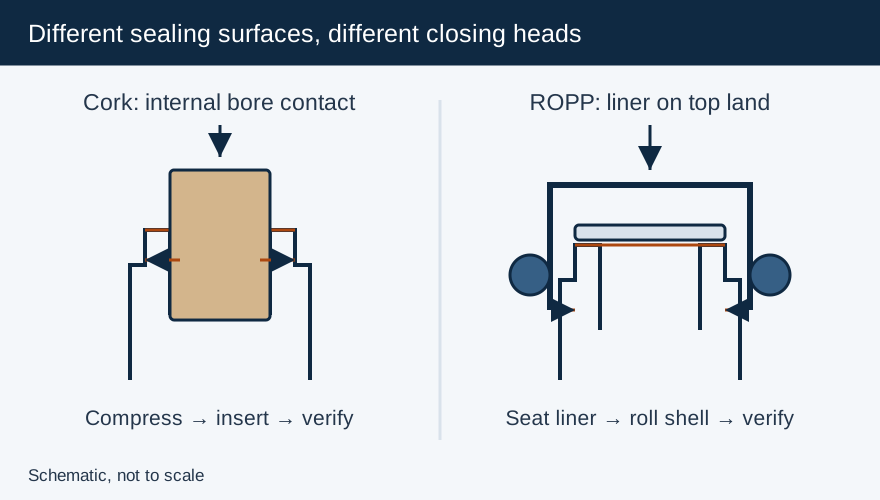
Cork vs Screw Cap: What Changes in the Bottling and Closing Process?
Compare still-wine cork insertion and ROPP screw capping by bottle finish, closing action, headspace control, liner and release tests.
Induction Seal Liners: One-Piece vs Two-Piece Wax-Backed Construction and Container Matching
Compare one-piece, wax-backed two-piece and wax-free release liners, including layer function, backing retention and container compatibility.
Induction Sealing Liners: Matching Bottles, Caps and Contents
Select foil liners by container material, opening behavior, product exposure and resealing needs; compare pressure-sensitive and compression liners.