
Induction Sealing Liners: Matching Bottles, Caps and Contents
Select foil liners by container material, opening behavior, product exposure and resealing needs; compare pressure-sensitive and compression liners.
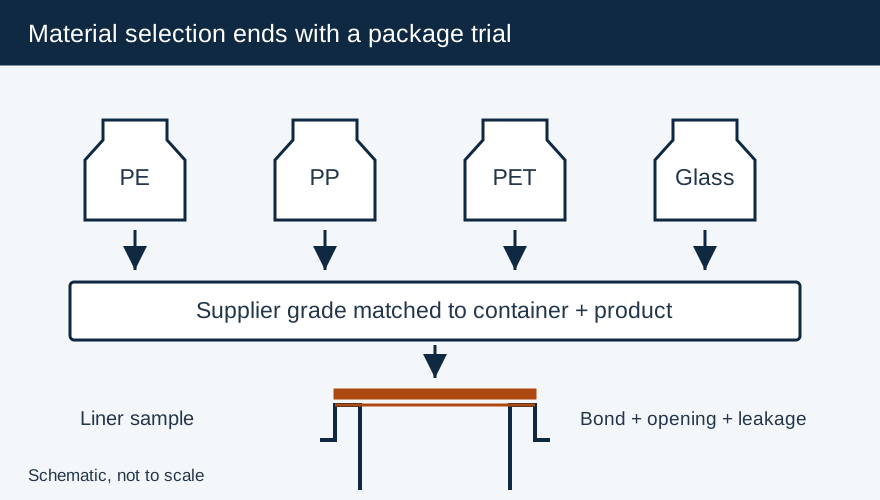
Specify the complete liner construction and container material before ordering an induction innerseal. A liner that bonds to one bottle material may release from another, and a good initial seal can still be unsuitable for the product or opening method. The selection record should identify the liner grade, container finish, contents, filling temperature and post-opening closure requirement.
| Package material or use | Information needed from the liner supplier | Verification on the package |
|---|---|---|
| HDPE / other PE | Heat-seal grade approved for the actual PE container | Bond continuity, opening behavior, rim condition |
| PP | PP-compatible liner grade and its processing conditions | Bond after cooling and storage; closure fit |
| PET | Grade approved for PET and the product exposure | Peel behavior, leakage and neck condition after sealing |
| Glass | Glass-compatible grade and specified finish/surface conditions | Adhesion on actual bottles, including filled and aged packs |
| Chemically aggressive contents | Product-compatible facing or protective barrier | Material compatibility and retained seal performance during storage |
| Gas generation or pressure change | Suitable vented package design | Vent function, liquid resistance and package deformation |
Selig’s Container Sealing portfolio identifies PE, PP, PET, PVC and glass as distinct material inputs for heat-seal selection. Obtain the converter’s grade-level compatibility data rather than choosing from the appearance of the foil.
Separate induction, pressure-sensitive and compression liners
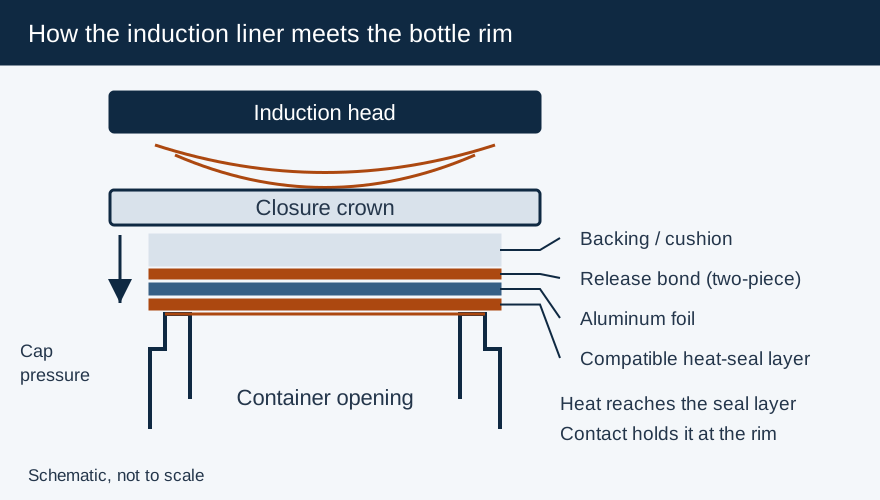
An induction liner contains conductive foil and a heat-seal layer. It bonds to the container mouth after the capped package is exposed to the induction field. A pressure-sensitive liner adheres through its adhesive under closure pressure, without the induction step. Selig recommends pressure-sensitive foam for dry products.
A primary foam or pulp liner seals through compression between cap and container. It can provide a resealing function when the cap is reapplied, but its performance depends on the complete closure design. Distinguish these mechanisms when specifying initial leak protection, consumer opening evidence and repeated use.
For retail OTC human drugs covered by 21 CFR 211.132, FDA CPG Sec. 450.500 identifies removable and reapplicable pressure-sensitive polystyrene foam mouth seals as ineffective tamper-resistant features. Evaluate an applicable package barrier and its labeling using the tamper-evident packaging guide.
Decide what stays in the closure after opening
In a one-piece induction construction, the liner remains together at the bottle mouth when the cap is removed. A two-piece design separates the foil innerseal from a backing that remains in the cap. Enercon describes wax or mechanical bonds for two-piece liners. Selig’s DeltaSeal uses a temporary polymer lamination to pulp reseal board; Top Tab combines a cap-retained pulp backing with a tabbed seal at the bottle.
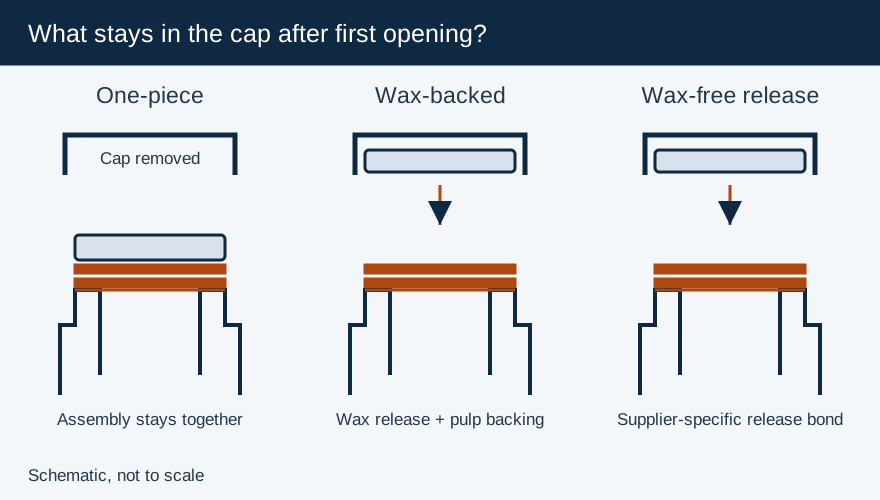
The retained backing gives the reclosed package a sealing surface after the foil is removed. Confirm the required repeated-opening and leakage performance with the cap supplier. One-piece designs can also be used with a separately engineered secondary liner or other resealing feature, so inspect the whole closure assembly rather than equating piece count with the package’s final behavior.
Specify opening behavior and product compatibility separately
Selig distinguishes clean peel, tamper-evident removal, pierceable and puncture-resistant constructions. Choose the experience the user needs, then test the actual seal. A pull tab improves grip; the material grade and bonded package determine the opening force and evidence left after opening.
For an aggressive formulation, Selig notes that an additional barrier may be needed to protect foil. For pressure equalization, its AirFoil and Circumvent families provide different vented solutions. A vent is an intentional gas path, so evaluate gas protection, liquid resistance and pressure behavior together. The integrity test must reflect that design rather than treating all gas movement as a defect.
Qualify a material change as a package change
Request samples representing the proposed grade, diameter, thickness and printing. Run them with production caps and bottles at the intended fill condition, cap application setting and sealer speed. Check full-rim bonding after cooling, the specified removal behavior, cap-retained backing where needed, and performance after the relevant storage and transport exposure.
Record the supplier grade and lot alongside the approved process window. If a liner changes, repeat the affected checks even when its color and dimensions look unchanged. Use the five-factor adhesion diagnosis to distinguish a material mismatch from torque, rim, alignment or speed problems.
Frequently Asked Questions
Can a PE-compatible liner be used on PET?
Use a grade explicitly approved for the PET container and qualify the complete package. Some grades support multiple materials, but that capability must come from the supplier’s specification.
Does a vented liner provide the same gas barrier as a closed foil membrane?
A vented package intentionally allows gas movement. Select and test it for the formulation’s pressure and barrier requirements.
Primary Sources & Referenced Standards
- Selig Group — Container Sealing Portfolio (Lift 'n' Peel, CoreSeal, DeltaSeal, FoilSeal, Top Tab, Uni-Gard, OenoSeal, Vented)
- Enercon: Getting Started with Induction Cap Sealing
- Troubleshooting Induction Seals: Container & Liner Material
- The Cary Company — Pressure Sensitive Liners vs. Heat Induction Liners Guide
- FDA CPG Sec. 450.500 — Tamper-Resistant Packaging Requirements for Certain Over-the-Counter Human Drug Products
More about Cap & Liner Selection
One-piece and two-piece wax-backed or polymer-bonded foil innerseals, container resin compatibility (PE, PP, PET, PVC, glass), and ROPP vs. cork closures.
Related Articles
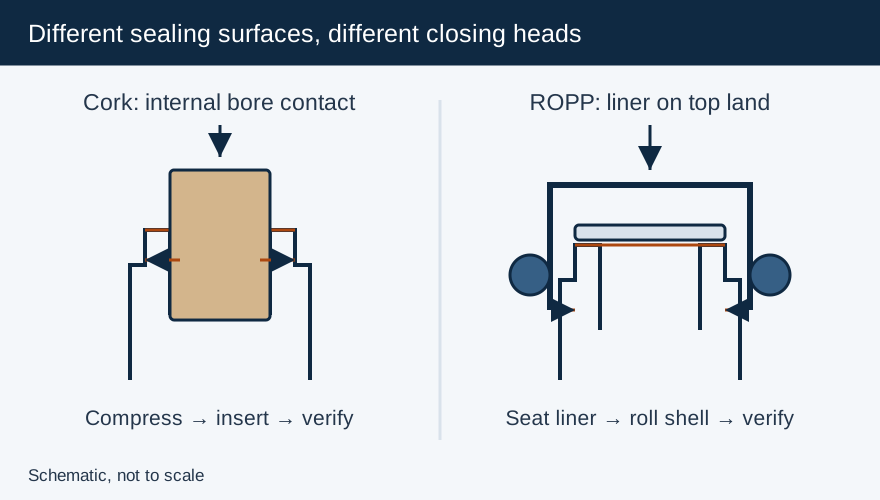
Cork vs Screw Cap: What Changes in the Bottling and Closing Process?
Compare still-wine cork insertion and ROPP screw capping by bottle finish, closing action, headspace control, liner and release tests.
Induction Foil Seal Adhesion Failure and Overheating Troubleshooting Guide
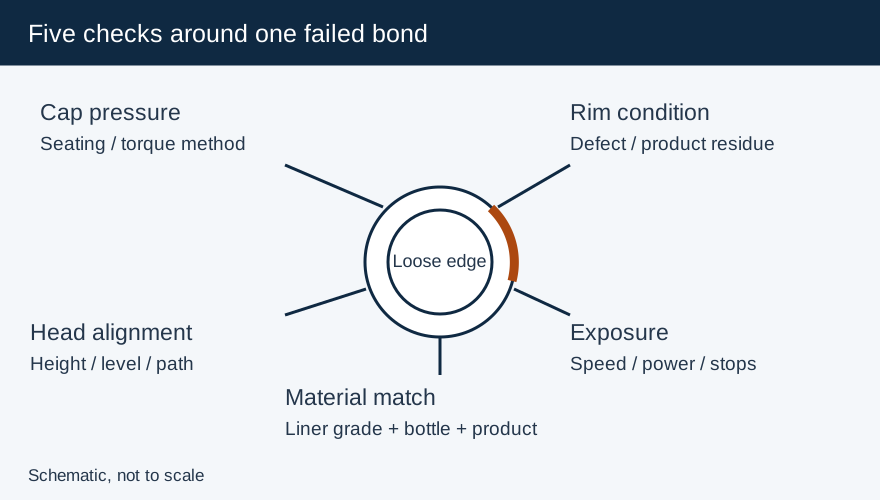
Use five checks—cap pressure, rim condition, coil alignment, conveyor exposure and material match—to isolate foil adhesion failure and overheating.
Induction Seal Liners: One-Piece vs Two-Piece Wax-Backed Construction and Container Matching
Compare one-piece, wax-backed two-piece and wax-free release liners, including layer function, backing retention and container compatibility.