
Bubble Leak Test: ASTM F2096, D3078 & Gross Leak Log
A bubble leak test detects gross package leaks in immersion fluid via ASTM F2096 internal pressurization or ASTM D3078 headspace vacuum emission.
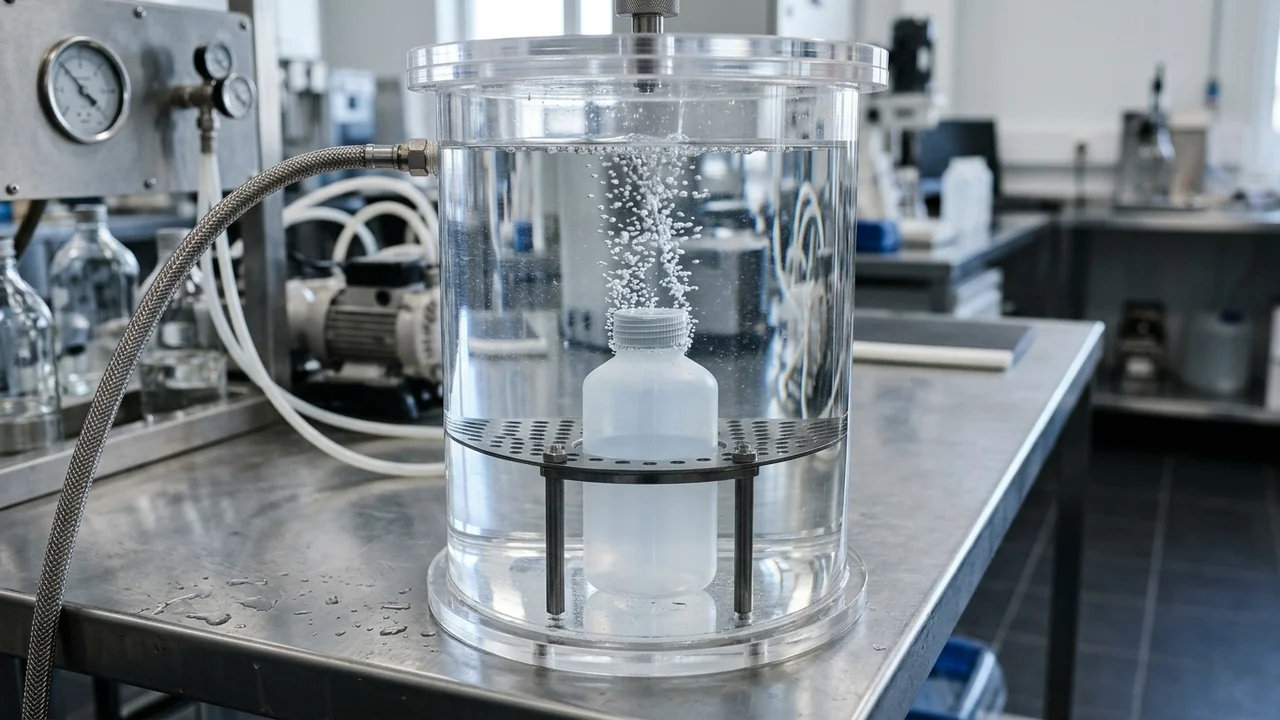
A bubble leak test detects a gross leak in a sealed package when a pressure difference drives internal gas out through a substrate hole or seal channel as visible bubbles inside an immersion fluid. Two active ASTM procedures detect those gross leaks in different ways: ASTM F2096-11R19 uses destructive internal pressurization by entry into the package to supply an internal air pressure, whereas ASTM D3078-02R21E01 draws chamber vacuum over flexible packages that already contain a headspace gas.
Within a broader seal integrity testing program, leak testing, bond-strength testing, and process inspection answer different questions, and an intact-looking foil or a normal thermal pattern alone does not establish all required package performance. Teams choosing between gross-leak immersion checks and non-destructive leak rate methods can map defect targets in the container closure integrity testing guide.
How Does ASTM F2096 Differ from ASTM D3078?
ASTM F2096-11R19 pressurizes a submerged package from the inside through entry into the package, whereas ASTM D3078-02R21E01 evacuates a transparent immersion chamber around a flexible package that already holds headspace gas.
Under Standard Test Method for Detecting Gross Leaks in Packaging by Internal Pressurization (Bubble Test) (F2096-11R19), supplying internal air pressure offers a practical gross-leak screen for substrate holes and seal channels in tray and pouch packages. Because F2096 requires entry into the package to supply an internal air pressure, the test is destructive. Method sensitivity is down to 250 μm (0.010 in.) with an 81% probability (see Section 11), with SI units regarded as the standard and parenthetical values provided for information only. Sensitivity has not been evaluated for porous materials other than spunbonded polyolefin or with nonporous packaging, and FDA Recognized Consensus Standards lists F2096-11 (Reapproved 2019) under Sterility recognition number 14-359 (entered 01/15/2013).
Under Standard Test Method for Determination of Leaks in Flexible Packaging by Bubble Emission (D3078-02R21E01), chamber vacuum draws existing headspace gas out of gross leaks in flexible packaging as visible bubbles, with inch-pound units regarded as standard and SI conversions in parentheses provided for information only. Interlaboratory testing reported in Section 12 limits D3078 sensitivity to 1 × 10⁻⁵ atm cm³/s (1 × 10⁻⁶ Pa m³/s) or even less sensitive, and FDA Recognized Consensus Standards lists D3078-02 (Reapproved 2021)e1 under Sterility recognition number 14-257 (entered 07/09/2014). Small leaks may not be detected under D3078 when viscoelastic effects on the products, or entrapped air, prevent passage through small openings, or when positive pressure inside the pouch after the vacuum is drawn may force the product to plug small leaks. Because D3078 covers flexible packaging containing headspace gas, a rigid liquid bottle requires selecting, validating, and naming its own appropriate test procedure rather than automatically labeling every bottle bubble check D3078.
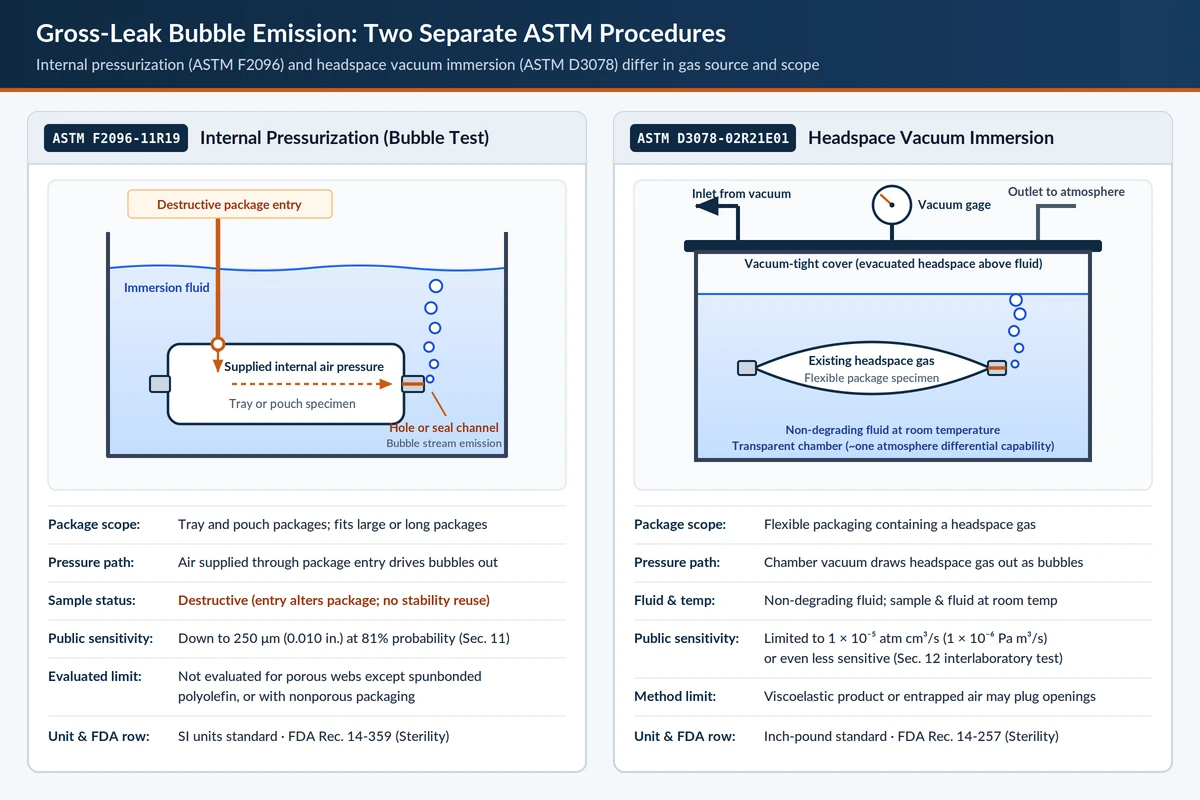
| Comparison Attribute | ASTM F2096-11R19 (Internal Pressurization) | ASTM D3078-02R21E01 (Bubble Emission) |
|---|---|---|
| Primary package scope | Tray and pouch packages | Flexible packaging containing a headspace gas |
| Driving pressure source | Internal air pressure supplied through package entry | External chamber vacuum over submerged headspace pack |
| Effect on specimen | Destructive: requires entry to supply an internal air pressure | Immersion fluid that does not degrade the package, at normal room temperature |
| Published sensitivity | Down to 250 μm (0.010 in.) at 81% probability (Section 11) | Limited to 1 × 10⁻⁵ atm cm³/s (1 × 10⁻⁶ Pa m³/s) or even less sensitive (Section 12) |
| Standard unit system | SI units standard (parentheses informational) | Inch-pound units standard (SI conversions informational) |
| FDA Sterility recognition | Recognition number 14-359 (entered 01/15/2013) | Recognition number 14-257 (entered 07/09/2014) |
What Equipment and Immersion Fluid Do Bubble Tests Use?
Bubble emission apparatus depends on how the pressure differential is created: ASTM D3078 uses a transparent vacuum chamber and an immersion fluid at normal room temperature, while ASTM F2096 supplies an internal air pressure through entry into the package.
For headspace vacuum bubble emission under D3078, the vacuum chamber shall be any transparent container capable of withstanding approximately one atmosphere pressure differential, fitted with a vacuum-tight cover. A vacuum gage, an inlet tube from a source of vacuum, and an outlet tube to the atmosphere shall be connected to the chamber cover. Before running the test, select an immersion fluid that does not degrade the package being tested, and bring both the test sample and the test fluid to equilibrium at normal room temperature.
When evaluating a package leak detector or bottle leak tester setup in the laboratory, package geometry and product behavior govern which hardware fits. F2096 internal pressurization is well suited to test laboratories where no single package material or size predominates, and it accommodates large or long packages that cannot fit inside fixed integrity chambers. Under D3078, detectable leak size varies with the contained product, the packaging material, and the selected test parameters.
How Does Bubble Testing Compare with Dye and Vacuum Decay?
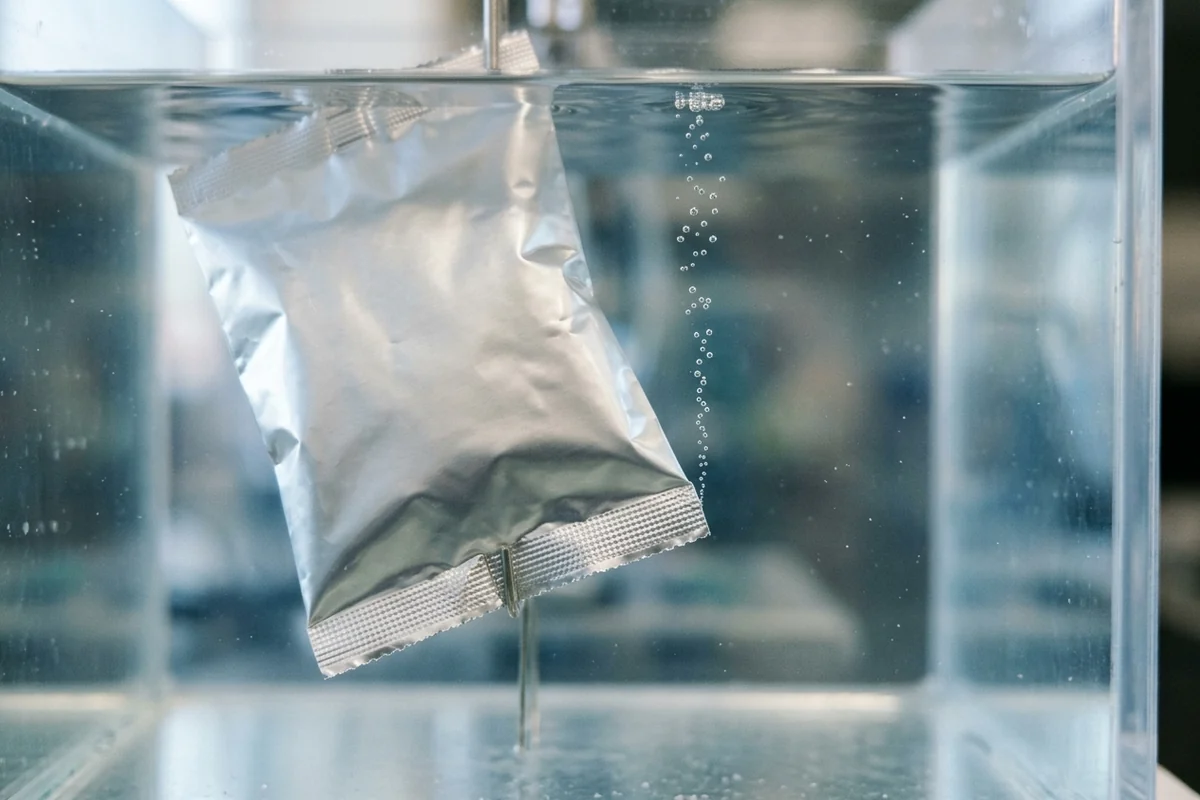
Laboratories choose between bubble emission, ASTM F1929-23 dye penetration, ASTM F2338-24 vacuum decay, and ASTM D5094/D5094M-24 closure leakage according to material porosity, sample destructiveness, and whether the check targets gross channels or non-visible leaks.
ASTM F1929-23 (Standard Test Method for Detecting Seal Leaks in Porous Medical Packaging by Dye Penetration) detects and locates a leak equal to or greater than a channel formed by a 50 µm (0.002 in.) wire in package edge seals formed between a transparent material and a porous sheet material. A dye penetrant solution is applied locally to the seal edge by injection, edge dip, or eyedropper; these test methods require that the dye penetrant solution have good contrast to the opaque packaging material, and after a specified time the package is visually inspected; the procedures are not quantitative, no indication of leak size can be inferred, and the methods are usually employed as a pass/fail test. F1929 applies only to individual leaks in a package seal and is limited to porous materials which can retain the dye penetrant solution and prevent it from discoloring the seal area for a minimum of 5 seconds; uncoated papers are especially susceptible to leakage and must be evaluated carefully, and the dye solution will wick through any porous material over time, but usually not within the maximum time suggested (see Appendix X1).
ASTM F2338-24 (Standard Test Method for Nondestructive Detection of Leaks in Packages by Vacuum Decay Method) permits non-destructive detection of leaks not visibly detectable, does not require dyes or gases, and detects package leaks by measuring the rise in pressure (vacuum loss) in an enclosed evacuated test chamber. Packages that can be evaluated include rigid and semi-rigid non-lidded trays, trays or cups sealed with porous barrier lidding material, rigid nonporous packages, and flexible nonporous packages; any package porous barrier surface has to be physically masked or blocked off during the test to prevent rapid loss of chamber vacuum from gas migration through the porous surface, test results are qualitative (Accept/Reject), and acceptance criteria are established by comparing control non-leaking packages, leaking packages, and simulated leaks using a calibrated gas flow meter.
For rigid and semi-rigid containers up to 4 L with threaded or lug-style closures, ASTM D5094/D5094M-24 may demonstrate container and closure integrity by the determination of gross leaks and may indicate the ability of a liquid container to survive the distribution environment without leaking, using Test Method A after transportation-induced vibration and high-temperature storage or Test Method B in a vacuum chamber, which is usually less severe than Test Method A and whose advantage is the shortness of the test; these methods may not be suitable to determine the leak resistance of containers intended for transport of hazardous materials. A cut strip can achieve acceptable peel strength and still leak through an unbonded pinhole or narrow channel, so mechanical peel testing in the seal strength test guide is a separate check from whole-package leak testing.
Where Do Bubble Tests Fit in Drug Stability Programs?
For sterile biological products, human and animal drugs, and medical devices, a container and closure system integrity test may replace sterility testing in the stability protocol at time points other than the product sterility test prior to release.
Under 21 CFR 211.94, drug product containers and closures shall not be reactive, additive, or absorptive so as to alter the safety, identity, strength, quality, or purity of the drug beyond the official or established requirements (211.94(a)); container closure systems shall provide adequate protection against foreseeable external factors in storage and use that can cause deterioration or contamination (211.94(b)); and standards or specifications, methods of testing, and, where indicated, methods of cleaning, sterilizing, and processing to remove pyrogenic properties shall be written and followed (211.94(d)). ASTM F2096 may be used to evaluate package integrity, and package integrity is crucial to consumer safety since heat-sealed packages are designed to provide a contamination-free or sterile environment, or both, to the product.
The February 2008 FDA container and closure system integrity guidance (Contains Nonbinding Recommendations, finalizing the January 28, 1998 draft at 63 FR 4272) refers to the entirety of packaging components that together contain and protect the product, including bottles, screw caps, closure liners, and container inner seals. Manufacturers of drugs and biologics purporting to be sterile must test each batch or lot to ensure sterility (21 CFR 211.167(a); 21 CFR 610.12), because container and closure system integrity tests cannot demonstrate a product’s initial sterility. Within stability protocols (21 CFR 211.166), any validated container and closure system integrity test should be acceptable when the detection technique is appropriate to the method and compatible with the specific product, and an appropriate test should be conducted annually and at expiration; listed alternatives include bubble tests, pressure/vacuum decay, trace gas permeation/leak tests, dye penetration tests, seal force or electrical conductivity and capacitance tests, and microbial challenge or immersion tests, while preservative effectiveness tests are not acceptable alternatives for monitoring container and closure system integrity. Samples which pass container and closure system integrity testing may be further utilized in the stability testing for that specific test period or interval only when the test is non-destructive and the sample is unaltered, which ASTM F2096 does not satisfy because the method is destructive in that it requires entry into the package to supply an internal air pressure.
For terminally sterilized medical devices, FDA recognition records for ISO 11607 (entered 12/18/2023) cover ISO 11607-1 Second edition 2019-02 [Including AMD1:2023] (Sterility recognition number 14-594 for materials and sterile barrier systems) and ISO 11607-2 Second edition 2019-02 [Including AMD1:2023] (recognition number 14-595 for forming, sealing, and assembly validation) rather than defining a bubble test procedure. For sterile pharmaceutical products, United States Pharmacopeia (2017) General Chapter USP <1207> (Package Integrity Evaluation, Sterile Products, USP-NF, Rockville, MD) provides guidance on the integrity assurance of nonporous packages and stresses package integrity assurance as a key component of the entire product life cycle, with detailed recommendations in <1207.1>, <1207.2>, and <1207.3>; <1207.2> advises referring to the most recent ASTM versions when a standard test method is referenced, and in some cases the scope of a referenced standard does not include the package types in <1207>, so establish that applicability before using <1207> as a qualification framework.
How Should You Log Seal-Channel vs Thread Bubbles?
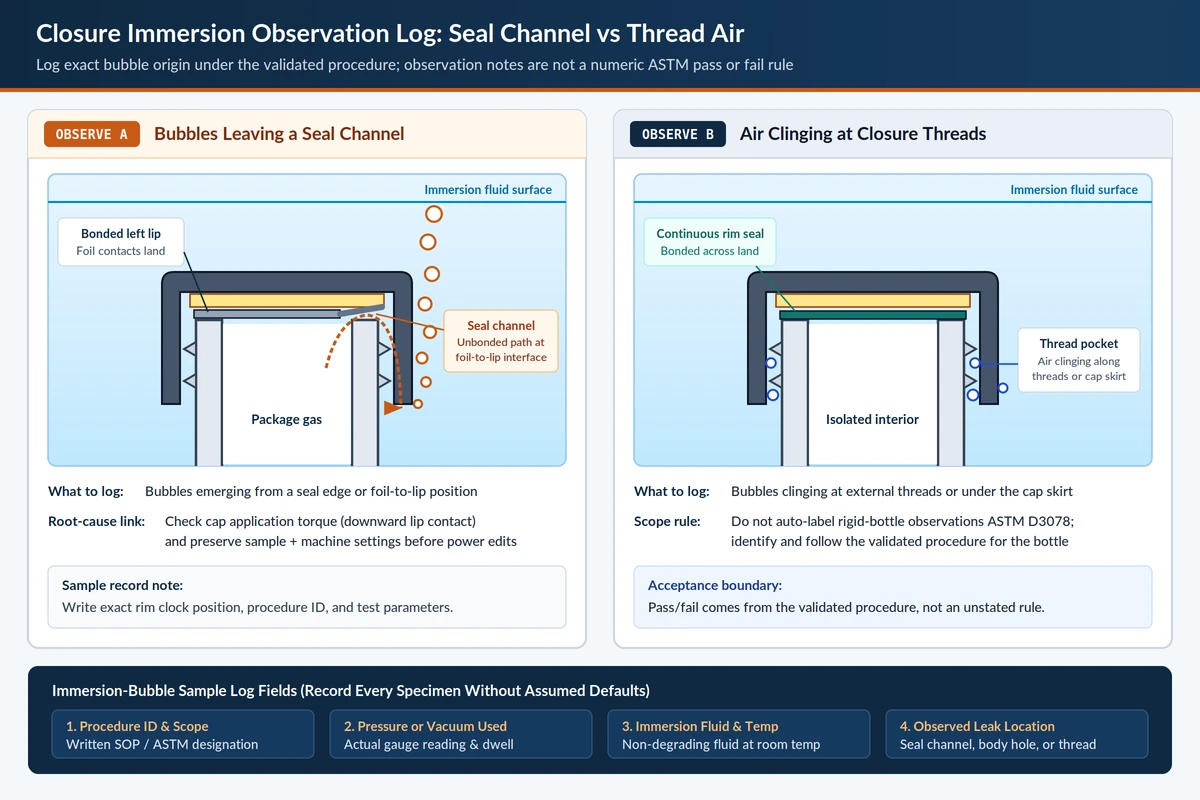
Bench technicians should record whether escaping bubbles originate at a foil-to-land seal channel or cling within external closure threads under the exact validated procedure ID, applying that procedure’s written acceptance rule rather than an assumed bubble-count shortcut.
On capped and induction-sealed rigid bottles, air trapped under cap skirts or threads during submersion is a different observation from gas escaping through an unbonded innerseal channel, and a bubble observation on a rigid bottle should be described under the actual validated procedure rather than automatically labeled D3078. Recording exact bubble location alongside the validated bottle procedure avoids mislabeling rigid-bottle checks as ASTM D3078. Proper application torque provides downward pressure for contact between the foil and the container lip, and induction sealing equipment cannot compensate for poor cap application torque, as covered on the application torque window. When an immersion check exposes a leaking foil edge, start by preserving the failed package and the machine settings; a loose edge can come from insufficient contact, unsuitable liner material, or uneven exposure, and raising power before distinguishing those causes can damage an already hot area, which is the path in the induction sealing troubleshooting guide.
Bubble Leak Test Checklist and Sample Observation Log
Use this pre-run checklist and blank immersion-bubble sample log to verify procedure scope, immersion fluid equilibrium, chamber connections, and leak-location notes on every batch check.
- Confirm that the written test specification matches the package type, distinguishing destructive internal pressurization (ASTM F2096-11R19), flexible headspace vacuum emission (ASTM D3078-02R21E01), or a dedicated validated bottle procedure.
- Verify that the immersion fluid does not degrade the package and that both the test fluid and samples have reached equilibrium at normal room temperature.
- Inspect the transparent chamber cover, vacuum gage, vacuum inlet tube, and atmospheric outlet tube on vacuum vessels, or check the internal air-supply entry fixture on pressurized setups.
- Record the applied pressure or vacuum parameter actually used, log exact bubble origin (foil-to-land seal channel, body wall, or external closure threads), and preserve any failed induction-sealed package with its line settings for root-cause review.
| Sample & Lot ID | Procedure ID & Package Type | Applied Pressure or Vacuum Used | Immersion Fluid & Room-Temp Equilibrium | Observed Bubble Location (Seal Channel, Wall, or Threads) | Validated Disposition & Preserved Line Settings |
|---|---|---|---|---|---|
| [ ] | [ ] | [ ] | [ ] | [ ] | [ ] |
| [ ] | [ ] | [ ] | [ ] | [ ] | [ ] |
| [ ] | [ ] | [ ] | [ ] | [ ] | [ ] |
Sources
- ASTM International: ASTM F2096-11R19 Standard Test Method for Detecting Gross Leaks in Packaging by Internal Pressurization (Bubble Test)
- ASTM International: ASTM D3078-02R21E01 Standard Test Method for Determination of Leaks in Flexible Packaging by Bubble Emission
- ASTM International: ASTM F1929-23 Standard Test Method for Detecting Seal Leaks in Porous Medical Packaging by Dye Penetration
- ASTM International: ASTM F2338-24 Standard Test Method for Nondestructive Detection of Leaks in Packages by Vacuum Decay Method
- ASTM International: ASTM D5094/D5094M-24 Standard Test Methods for Gross Leakage of Liquids from Containers with Threaded or Lug-Style Closures
- Electronic Code of Federal Regulations: 21 CFR 211.94 Drug Product Containers and Closures
- U.S. Food and Drug Administration (February 2008): Container and Closure System Integrity Testing in Lieu of Sterility Testing as a Component of the Stability Protocol for Sterile Products
- U.S. Food and Drug Administration Recognized Consensus Standards: ASTM F2096-11 (Reapproved 2019), Recognition Number 14-359
- U.S. Food and Drug Administration Recognized Consensus Standards: ASTM D3078-02 (Reapproved 2021)e1, Recognition Number 14-257
- U.S. Food and Drug Administration Recognized Consensus Standards: ISO 11607-1 and ISO 11607-2, Recognition Numbers 14-594 and 14-595
- United States Pharmacopeia (2017): General Chapter USP <1207> Package Integrity Evaluation, Sterile Products, USP-NF, Rockville, MD
- United States Pharmacopeia (2017): General Chapter USP <1207.2> Package Integrity Leak Test Technologies, USP-NF, Rockville, MD
More about Seal Integrity Testing
Leak testing, peel and opening checks, online inspection and tamper-evident packaging requirements for the relevant product.
Related Articles
Seal Strength Test: Peel Force, Fixtures & Failure Modes
How ASTM F88 seal strength testing controls tail support angle, peel force limits, units, and failure modes across flexible and foil-sealed packaging.
PET vs Glass Bottle Induction Sealing Guide
Compare PET and glass induction sealing on interfacial bond, land treatment, neck thermal limits, liner grade, and operating-window verification.
Closure Integrity Testing After Induction Sealing
Select leak and seal-quality tests by package purpose, method scope and validated sensitivity; distinguish presence inspection, peel strength and integrity.