
PET vs Glass Bottle Induction Sealing: Neck Finish Thermal Limits and Liner Selection
Compare PET and glass induction sealing on interfacial bond, land treatment, neck thermal limits, liner grade, and operating-window verification.
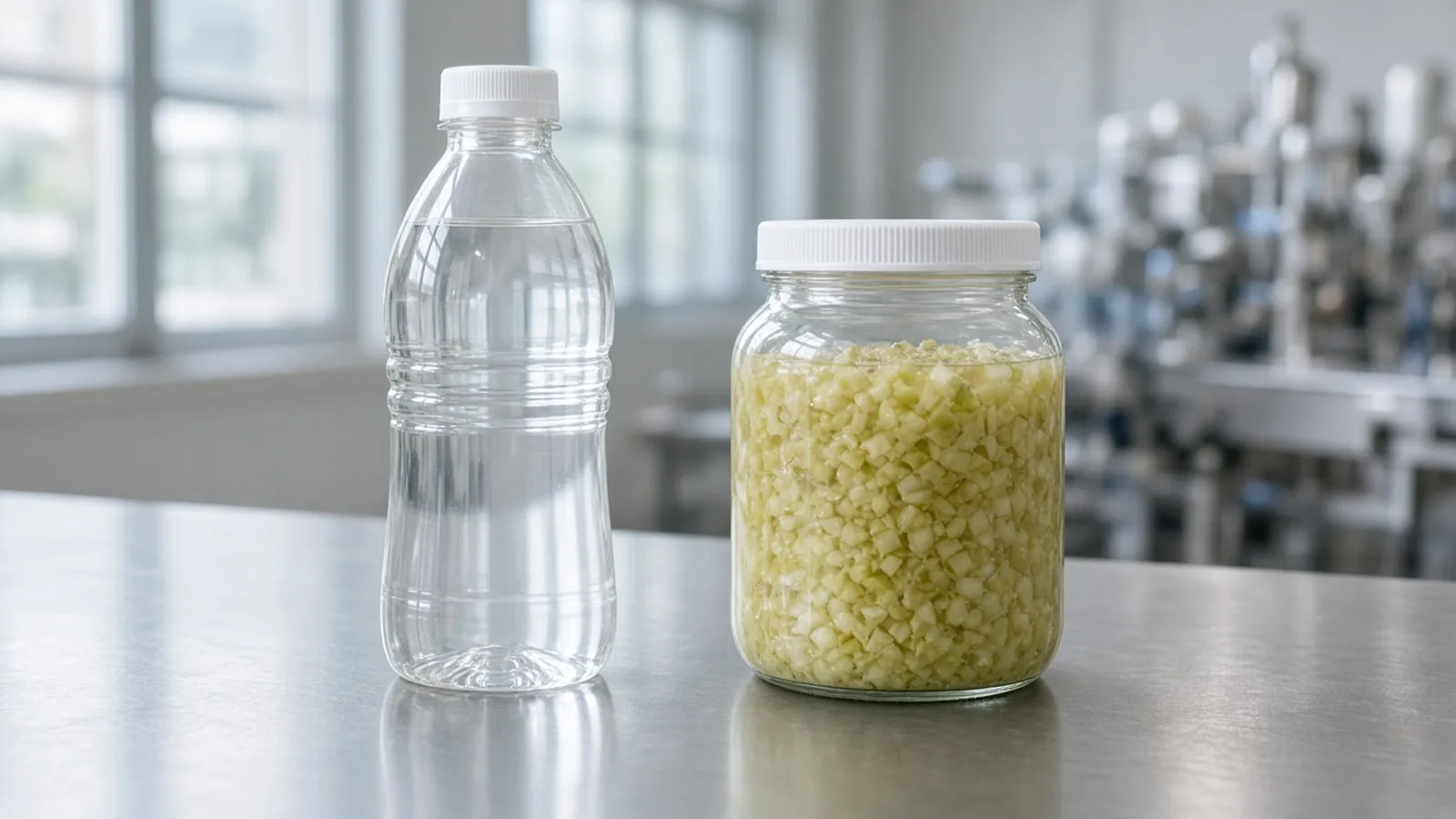
PET plastic bottles and glass containers do not share one induction-sealing recipe. The land interface, thermal mass, surface-treatment rules, liner facing, and verification methods all change with the container. Use this comparison with the seal integrity testing hub before a PET-to-glass or glass-to-PET changeover.
Sealing a membrane to a glass container by the induction method provides at the very best a peelable seal because, unlike plastic containers, glass does not melt on the land area under the induction system. An induction seal liner that gives a ‘true weld’ seal to a container has a sealing surface made of a material compatible with the container land area, meaning that when the liner is broken, the foil structure cannot be completely cleared from the land area. A peelable induction liner peels cleanly from the container land area without leaving film deposits or foil because its heat-sealable layer is made with a modified resin that is not especially compatible with the land area material, and it does not seal as aggressively as a true weld liner.
Glass is colder and in most cases has a greater mass than plastic, creating a ‘heat sink’ effect during induction sealing that requires increased dwell time or power so the foil maintains temperature for a longer period of time. Plastic containers with screw-on plastic caps are easiest to induction seal, whereas glass containers pose challenges and may need to be treated before the lip of the container will accept a seal.
| Decision factor | PET plastic bottle | Glass container |
|---|---|---|
| Bond at the land | Compatible seal layer can form a true weld | At best a peelable seal because glass does not melt |
| Heat-sink behaviour | Lower mass than glass in most cases | Colder and greater mass; needs more dwell or power |
| Product fill | Plastic containers with plastic caps are easiest | Dry or viscous fills normally seal; aqueous fills are difficult |
| Land surface treatment | Must not be flame, corona, or chemically treated | Specialty glass liners; finishes vary and treatment can matter |
| Liner selection | Match facing to PET early; Universal grades cost more and narrow the window | Use glass-designed liners and confirm with lab testing |
Keep the package record with the induction sealing liners selection step and the closure integrity testing methods used after sealing.
Interfacial Bonding and Thermal Mass: Thermoplastic True Weld vs Glass Heat-Sink Peel
In seal-to-glass induction applications, aqueous based products are difficult to seal while dry or viscous products normally do not present difficulty, and various surface treatments of glass on the market can have a significant impact on achieving a good seal to glass. Enercon’s rules of thumb state that glass containers with dry product can always be sealed, packagers should check with their inner seal supplier when sealing liquids in glass, and induction sealing remains effective when liquid product is on the container lip except for some liquids on glass containers.
When induction sealing with a metal cap, the sealing equipment heats both the inner-seal foil and the metal cap; the metal cap stays hot for a while, presenting a possible safety problem, and hot metal caps could also melt the plastic threads of a container. For glass containers, specialty induction liners are specifically designed for glass, and because finishes on glass can vary, comprehensive lab testing is required. Induction liners can work with HDPE, LDPE, PS, PET and PVC plastic jars and bottles as well as glass containers; plastic containers with plastic caps create the easiest and most consistent seal, while glass containers with plastic caps can be induction sealed though some glass containers may need to be treated to achieve a proper seal.
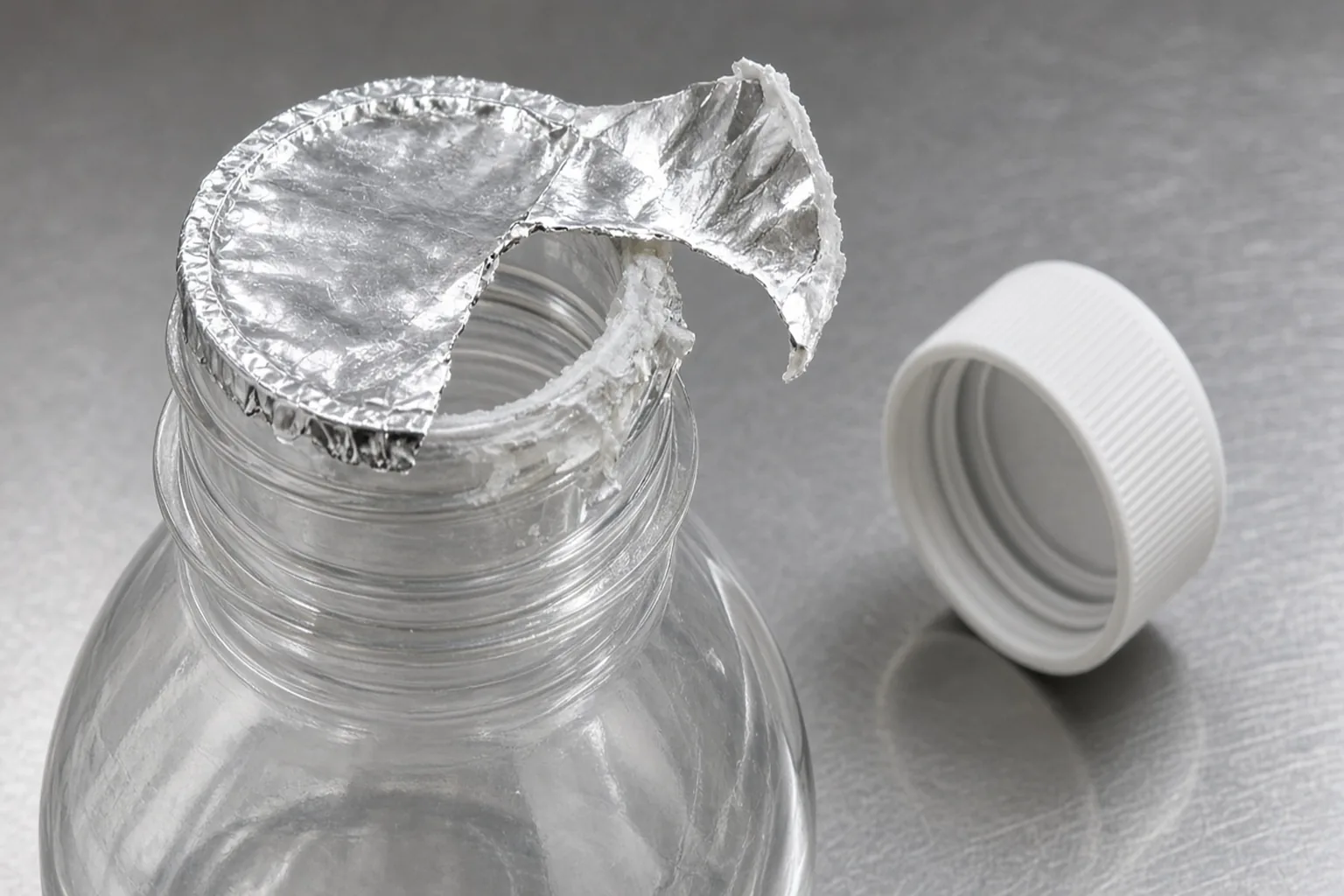
In Enercon’s trial sealing two LDPE bottles using the same parameters (100% power through a deep tunnel sealing head)—one with an incompatible liner and one with a universal liner—both seals appear identical at first glance after cooling, showing that visual inspection alone is not enough because the incompatible liner pops right off with a slight touch.
Surface Treatment Polarity Inversion: Treated Glass vs Untreated Plastic Neck Finishes
To help ensure proper induction seals on containers, the container land area should be flat, smooth, and a minimum of 1mm wide, and the neck area and land area must not be flame treated or chemically treated in any way because the induction liner does not seal properly to treated areas, giving weak to no seal at all.
Enercon’s troubleshooting guide lists a bottle neck finish that has been treated with flame, corona, or chemically—alongside an induction liner incompatible with the bottle material or imperfections in the container finish/land area—as a root cause of failure to seal. Selig’s FAQ & Troubleshooting guide identifies part of the land area being contaminated with product, flame treated, or chemical treated—along with low closure on-torque, unlevel land area, or product touching the liner—as probable causes of partial seals or a high percentage of leakers, and also lists land area contamination and unlevel land area under partial seals with a low percentage of leakers (less than 2%). Selig’s FAQ & Troubleshooting guide lists part of the land area being contaminated with product, flame treated, or chemical treated, excessive exposure time (low conveyor speed), and excessive power setting (field strength too high) as probable causes of both foil corrosion and pinholing.
Do not carry a glass-line surface-treatment habit onto a plastic or PET neck finish. Confirm land flatness and cleanliness before raising power. Use the adhesion and overheating guide when partial seals and thermal damage appear together.
PET Neck Finish Thermal Limits, Land Meltdown, and Preform Neck Crystallization
Excessive heat during induction sealing can result in leakers, melt down of the container land area, and an induction seal liner that is overheated, melted, or destroyed, which could burn and produce an odor and/or contaminate the product. The container acts as a heat sink that absorbs heat from the induction seal liner when sufficient pressure is applied to the land area; if an induction seal liner by itself is passed through the induction coil, it could reach a temperature of 600°F/ 315°C or more, and if a liner is not held evenly around the circumference, the uncontacted area will overheat and the land area could suffer excessive meltdown.
Containers that are hot filled require special attention to dwell time under the sealing head: if a container is hot filled at 200°F/ 93.3°C, the additional energy from the induction coil can heat the liner and the land area of the container to approximately 400°F. When containers leak or leak upon slight pressure because too much heat was applied to the seal area and the land area of the bottle or closure melted down, the solution is to decrease power (H) and increase conveyor speed (T). When a peelable liner is hard to remove and/or cap removal torque is excessive because too much heat and/or pressure was applied to the seal area and the land area of the bottle or closure melted down, the solution is to lower application torque (P), lower power setting (H), and/or increase conveyor speed (T).
When sealer output is too high or line speeds are too slow, overheating of the liner occurs: the liner will often wrinkle badly, melt into the lip of the bottle, give off a burned smell that can contaminate the product, and show discoloration or burning on multilayer pulpboard liners. On two-piece liners, an undersized liner disk can allow plastic from the container finish to squeeze and bond to the closure pulp backing, causing excessive closure removal torque.
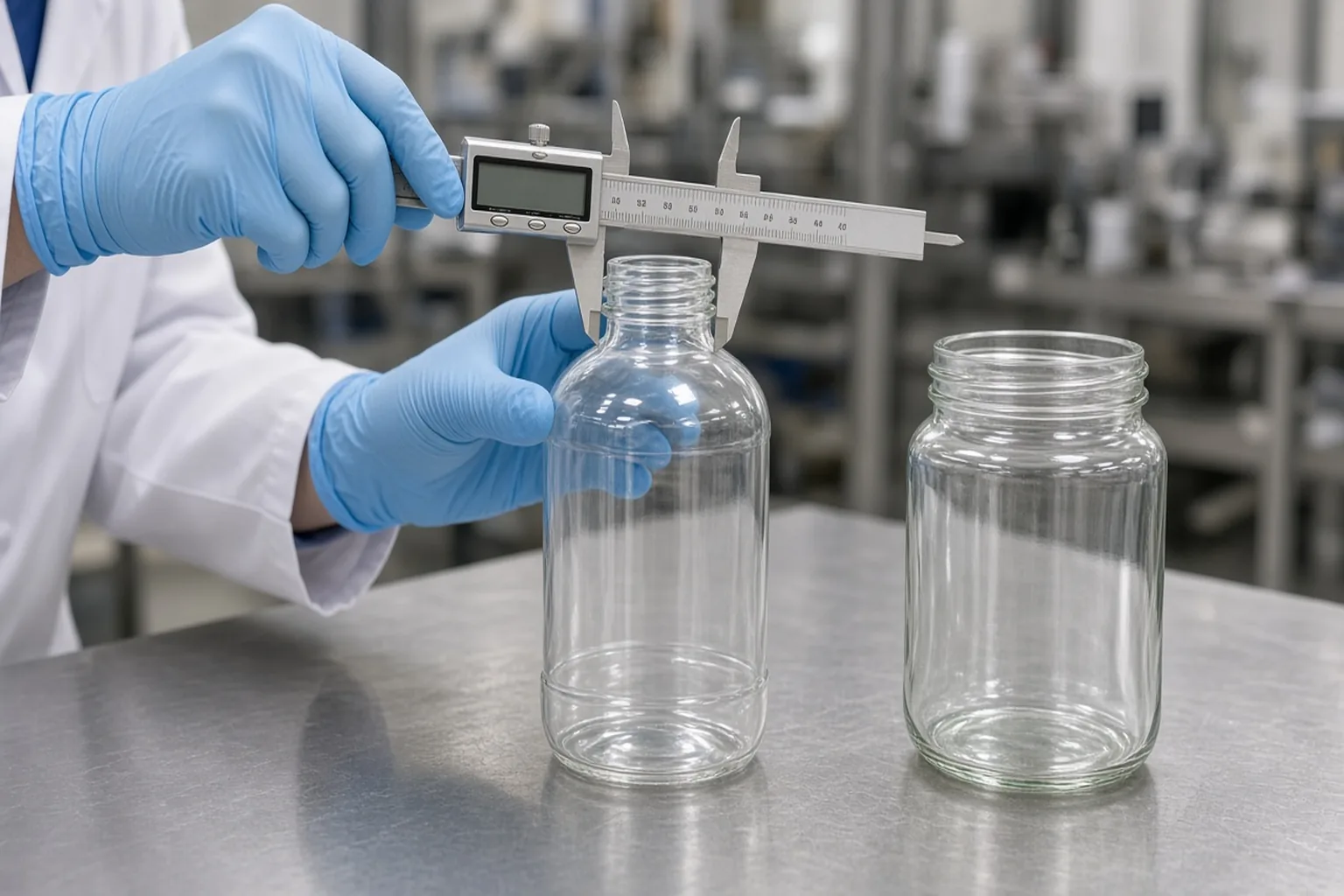
The Nissei ASB CM-2000M crystallizes PET preform necks up to 113mm diameter at a production rate of up to 2,000 preforms per hour, while the CM-6000M crystallizes PET preform necks up to 77mm diameter at up to 6,000 preforms per hour. Sidel’s BoostPRIME PET hot-fill packaging solution is scoped to single-serve JNSDIT (juice, nectar, soft drink, isotonics, tea) beverages filled in PET bottles up to 1.2L at a temperature of 85–88°C, while traditional heat-resistant (HR) PET bottles use high PET crystallinity and vacuum panels to absorb volume variations between hot and cold conditions. Krones’ NitroHotfill process fills hot products of up to 90 °C into panel-free PET containers with volumes up to 2.0 litres and neck finish diameters up to 38 mm by dosing liquid nitrogen (N2) after filling to raise interior pressure to 1.5 to 2 bar before cooling to about 0.3 bar.
| Hot-fill PET process | Documented scope |
|---|---|
| Preform neck crystallization | Prevents neck deformation during hot filling and capping for heat-resistant PET bottles and jars |
| BoostPRIME hot-fill PET | Single-serve juice, nectar, soft drink, isotonics, and tea in PET bottles |
| NitroHotfill | Hot product into panel-free PET containers with liquid nitrogen dosing after filling |
For fill-temperature recipe transfer, continue with the hot-fill versus cold-fill induction window.
Induction Liner Architecture, Universal vs PET-Specific Grades, and Generator Frequency
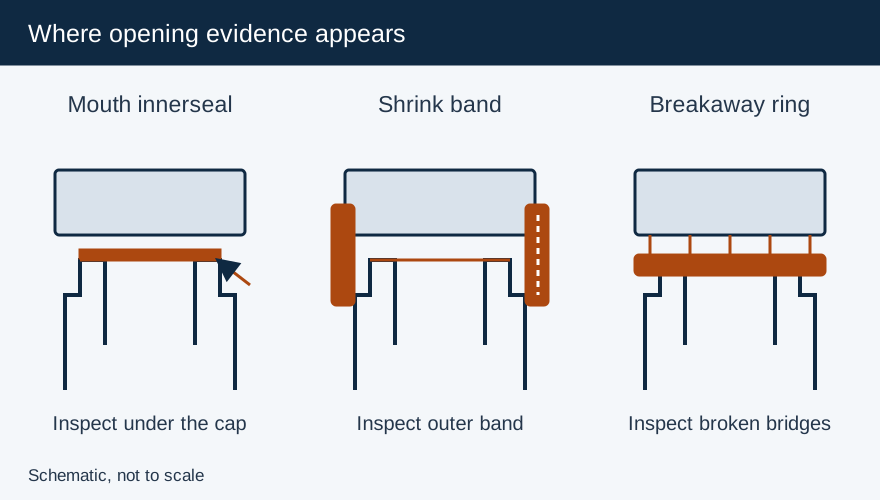
Selig states that identifying the container material early in the selection process is particularly important when an induction seal is considered because the liner heat seal material depends on the container material it needs to bond to, listing common container materials as Polypropylene (PP), Polyester (PET), Polyvinyl Chloride (PVC), Polyethylene (PE), and Glass. Selig categorizes induction liner removal characteristics into four types: Clean Peel (peels away cleanly in one piece leaving no residue), Tamper Evidence (peels away but leaves residue on the container opening showing visual evidence of entry), Pierceable (punctured or torn by a finger), and Puncture Resistant (includes a barrier layer to protect the foil and must be cut with a tool).
Selig FoilSeal™ heat induction foil innerseals are offered for sealing to a variety of resin types including PE, PP, PET, PVC, and treated glass, with adhesion varying by container material. Selig Uni-Gard™ is a one-piece induction foil liner range that provides higher operating speeds and the flexibility to run at wider induction operating parameters. Selig Lift ‘n’ Peel™ and Top Tab™ half-moon center-tab induction liners are recommended for 20-63mm closure diameters (with diameters under 20mm not recommended due to tooling/layout limitations), while Lift ‘n’ Peel™ Wide Mouth is recommended for 53 - 120mm (or 63-120mm) diameter openings.
Selig DELTASEAL™ two-piece induction liners consist of aluminum foil coated with a heat seal layer that is temporarily polymer-laminated to a pulp reseal board backing material, eliminating the use of wax and creating a stable liner over a wider temperature range. Selig’s DeltaSeal™ 9000 is a temporary polymer-bonded 2-piece induction seal liner for glass jars that is EU fatty-food contact compliant for foods containing oils and fats. TekniPlex ProTecSeals IHS paper-based induction heat seal liners are made from tree pulp and can be applied to glass, PET, polyethylene, and polypropylene containers for dry pharma, nutrition, and food products such as vitamins, supplements, protein powders, and peanut butter.
TricorBraun states that liner suppliers commonly offer one grade specifically for HDPE bottles and a different grade with a different facing layer designed for PET bottles, whereas a Universal grade that works on both bottle materials is 10 to 15% dearer and generally has a much narrower operating window requiring more accurate line settings.
Solid-state induction generators normally operate in the 26 to 100 kHz range (whereas older vacuum tube units operated at approximately 450 kHz); at very high frequencies, ‘skin effect’ concentrates current on the outside edge of the foil disc and can scorch the outside edge of the pulp disc on two-piece liners, particularly in closures larger than 38mm in diameter. On 2-piece wax-laminated liners, if the induction unit operates at a frequency higher than 50kHz, there may be a problem with wax absorption causing excessive closure removal torque, which is corrected by re-calibrating the induction unit to a lower operating frequency or increasing exposure time.
| Liner decision | What to record |
|---|---|
| Container material | Match heat-seal facing to PET, glass, or the named plastic resin |
| Removal style | Clean Peel, Tamper Evidence, Pierceable, or Puncture Resistant |
| Construction | One-piece versus two-piece; wax-backed versus temporary polymer bond |
| Grade family | PET-specific facing versus Universal grade cost and window trade-off |
| Generator frequency | Solid-state frequency band and wax-absorption risk on two-piece liners |
Construction choice continues in the one-piece versus two-piece liner comparison.
Neck Geometry, Application Torque, Operating Window Calibration, and ASTM Verification
The closure and container combination requires adequate thread engagement or rotation, specifically 360˚ for a single-start thread and 120˚ for a 3-start thread, to help ensure uniform pressure is generated when fully tightened. When a closure is screwed onto a container, there should be space within the closure to allow a minimum of 0.5mm overhang of the liner around the container neck that remains flat/horizontal when fully tightened, and at least 0.030” (0.75mm) per-side clearance between bottle and closure beyond the bottle land area so the liner is not crimped down or wrinkled. Too high on-torque can distort the neck of a container by applying more pressure than the container can withstand—causing the neck and land area to deform and become non-flat—or cause the bottom of the closure to touch the container shoulder (‘H’ dimension bottoming out), resulting in weak and inconsistent seals.
Selig’s approximate guide for cap on-torque is one-half the closure diameter in mm expressed in in-lbs: for a 33mm closure, on-torque is 13 to 20 in-lbs, off-torque before induction sealing is typically lower (9 to 15 in-lbs), and off-torque after induction sealing is much lower (6 to 14 in-lbs typical). Enercon states that the suggested application torque to achieve a good induction seal is one-half of the cap diameter in inch/pounds (for example, 18-20 inch/pounds for a 38mm closure and 25-26 inch/pounds for a 53mm closure), with published torque table ranges from 6 to 9 inch/lbs (15 mm) and 12 to 18 inch/lbs (28 mm) up to 17 to 26 inch/lbs (38 mm) and 21 to 36 inch/lbs (53 mm). In Enercon’s torque demonstration on an 83 mm cap, applying the recommended target torque of approximately 41 inch-pounds (half the cap size in inch-pounds) produced a clean, consistent seal around the entire land area, whereas applying half of the recommended torque produced an inconsistent seal where the liner bonded in some areas and popped off easily in others.
A 3mm or 1/8″ gap between the induction foil and the coil is recommended with the sealing head parallel to the conveyor, and a minimum of one-minute is needed after sealing to allow cool down, during which the container must not be bumped, banged, roughly handled, or opened. To determine the operating window in Enercon’s procedure, once a perfect seal is achieved, increase power by 5% until there are signs of liner burning or wrinkling and then reduce power by 1% until burning/wrinkling stops (top power level); from the first perfect seal, reduce power by 5% until imperfect and increase by 1% until a perfect seal is achieved (low power level). TricorBraun’s qualification protocol holds conveyor speed and application torque constant, passes 10 bottles each at 60%, 70%, 80%, and 90% induction settings, waits 20 mins for cooling before opening 5 packs per level on a torque tester, and re-tests packs at 2 hours and 24 hours after sealing because induction seals strengthen for up to 48 hours after application.
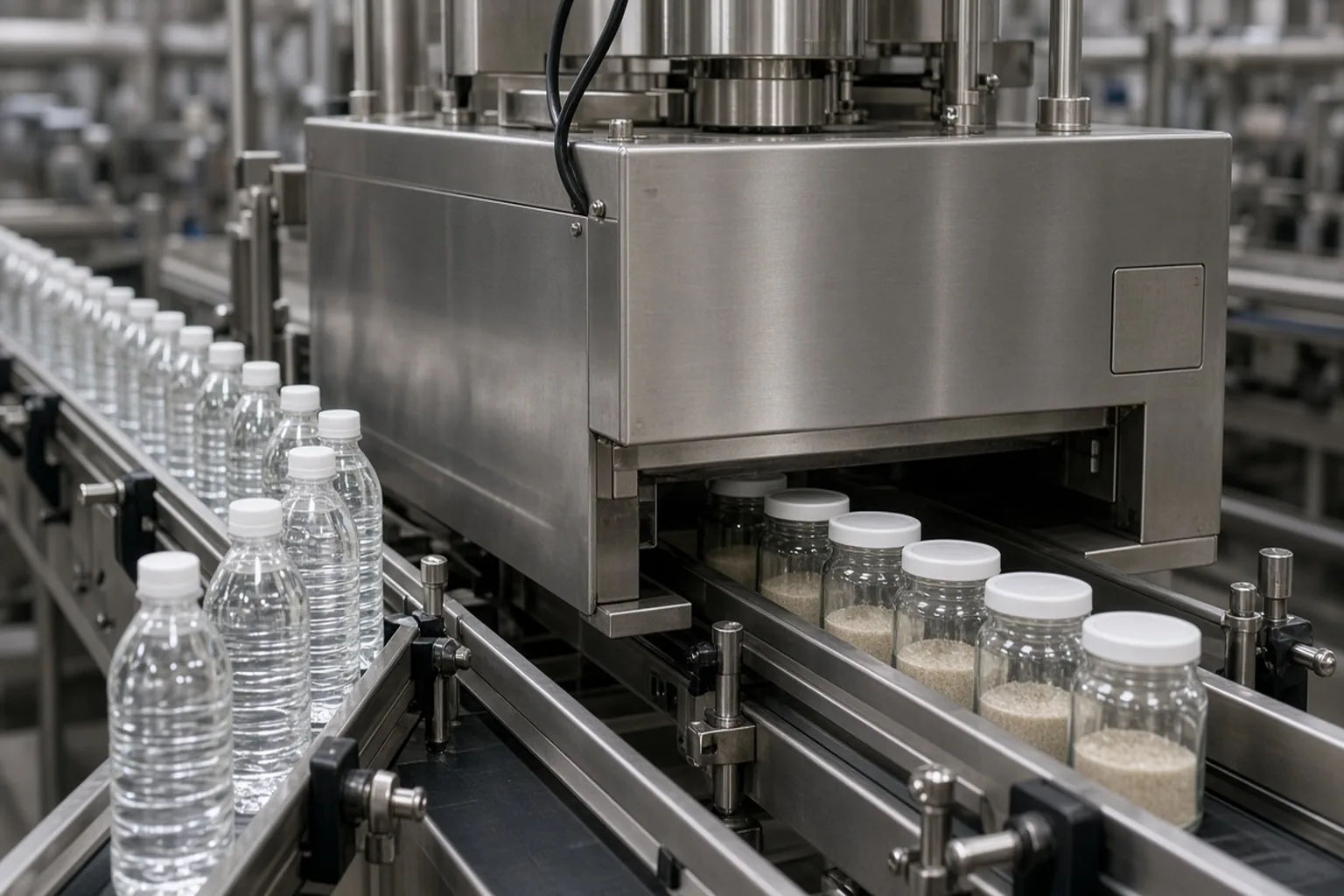
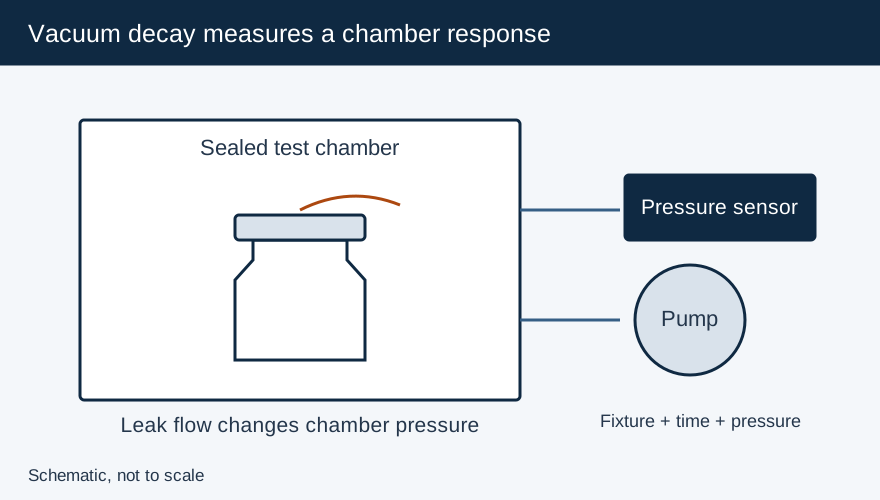
ASTM D5094/D5094M-24 (Standard Test Methods for Gross Leakage of Liquids from Containers with Threaded or Lug-Style Closures) provides qualitative gross leak tests (Test Method A vibration and high-temperature storage; Test Method B vibration and vacuum chamber) for rigid and semi-rigid containers up to 4 L stored or transported upright, inverted, or on the side. ASTM F2338-24 (Standard Test Method for Nondestructive Detection of Leaks in Packages by Vacuum Decay Method) detects leaks in rigid, nonporous packages such as plastic bottles with screw caps down to hole defects of at least 5 μm in diameter tested at a target vacuum of –5·E4 Pa (–500 mbar), with a test sensitivity of approximately E-3.4 Pa·m3·s-1.
Torque setup detail stays on the application torque window.
PET-to-Glass Changeover and Liner Qualification Record
Before releasing a PET-to-glass or glass-to-PET induction changeover, keep one package record that names the container material, land treatment state, liner facing grade, application torque, induction power and conveyor speed, cool-down hold, and the peel, leak, and vacuum-decay methods used. Link the record upward to seal integrity testing and retain sibling checks for liner selection, adhesion failure, hot-fill window, application torque, and one-piece versus two-piece construction.
Do not transfer a glass high-dwell recipe onto PET without re-opening the operating window, and qualify a glass-designed liner and lab-test the glass finish before release.
Common Questions
Can glass containers form a true melt weld under induction sealing?
Sealing a membrane to a glass container by the induction method provides at the very best a peelable seal because, unlike plastic containers, glass does not melt on the land area under the induction system.
Should plastic or PET neck finishes be flame, corona, or chemically treated before induction sealing?
To help ensure proper induction seals on containers, the container land area should be flat, smooth, and a minimum of 1mm wide, and the neck area and land area must not be flame treated or chemically treated in any way because the induction liner does not seal properly to treated areas, giving weak to no seal at all.
How do Universal liners compare with PET-specific grades on cost and operating window?
TricorBraun states that liner suppliers commonly offer one grade specifically for HDPE bottles and a different grade with a different facing layer designed for PET bottles, whereas a Universal grade that works on both bottle materials is 10 to 15% dearer and generally has a much narrower operating window requiring more accurate line settings.
Sources
- Selig Group — Practical Handbook of Induction Sealing
- Selig Group — Induction Sealing FAQ and Troubleshooting
- Selig Group — Container Sealing Solutions Portfolio
- Selig Group — PHT Guide for Induction Sealing
- Enercon Industries — Achieving a Perfect Seal Cap Sealer Handbook
- Enercon Industries — Induction Cap Sealing Basics
- Enercon Industries — Liner Options for Sealing Capped Containers
- Enercon Industries — Troubleshooting Induction Seals Container and Liner Material
- Enercon Industries — Inconsistent Application Torque Equals Inconsistent Seals
- Enercon Industries — Best Cap Torque for Consistent Induction Seals
- Enercon Industries — Get Consistent Seals Dial In Your Induction Sealing Window
- SKS Bottle and Packaging — Understanding Induction Liners
- TricorBraun — Foil Induction Sealing Guidelines
- Nissei ASB Machine — Neck Crystallizer CM Series
- Sidel — Hot Fill Lines for PET Bottles
- Krones — NitroHotfill Technical Brochure
- Packaging Europe — Selig DeltaSeal Nine Thousand glass jar liner launch
- Packaging Europe — TekniPlex ProTecSeals paper-based induction liners
- ASTM International — Seal Strength of Flexible Barrier Materials
- ASTM International — Gross Leakage of Liquids from Containers with Threaded or Lug-Style Closures
- ASTM International — Nondestructive Detection of Leaks in Packages by Vacuum Decay Method
Frequently Asked Questions
Can glass containers form a true melt weld under induction sealing?
Sealing a membrane to a glass container by the induction method provides at the very best a peelable seal because, unlike plastic containers, glass does not melt on the land area under the induction system.
Should plastic or PET neck finishes be flame, corona, or chemically treated before induction sealing?
To help ensure proper induction seals on containers, the container land area should be flat, smooth, and a minimum of 1mm wide, and the neck area and land area must not be flame treated or chemically treated in any way because the induction liner does not seal properly to treated areas, giving weak to no seal at all.
How do Universal liners compare with PET-specific grades on cost and operating window?
TricorBraun states that liner suppliers commonly offer one grade specifically for HDPE bottles and a different grade with a different facing layer designed for PET bottles, whereas a Universal grade that works on both bottle materials is 10 to 15% dearer and generally has a much narrower operating window requiring more accurate line settings.
More about Seal Integrity Testing
Leak testing, peel and opening checks, online inspection and tamper-evident packaging requirements for the relevant product.
Related Articles
Closure Integrity Testing After Induction Sealing
Select leak and seal-quality tests by package purpose, method scope and validated sensitivity; distinguish presence inspection, peel strength and integrity.
Tamper-Evident Packaging: Induction Foil Liners vs Shrink Bands and Breakaway Closures
Compare foil innerseals, shrink bands and breakaway closures by visible entry evidence and leak protection, with the scope of 21 CFR 211.132.