
Rotary Capping Machine: Pitch, Speed & Line Fit
A rotary capping machine scales speed to 240 CPM with starwheel pitch and multi-head dwell—learn when rotary beats inline, ROPP fit, and sealer handoff.
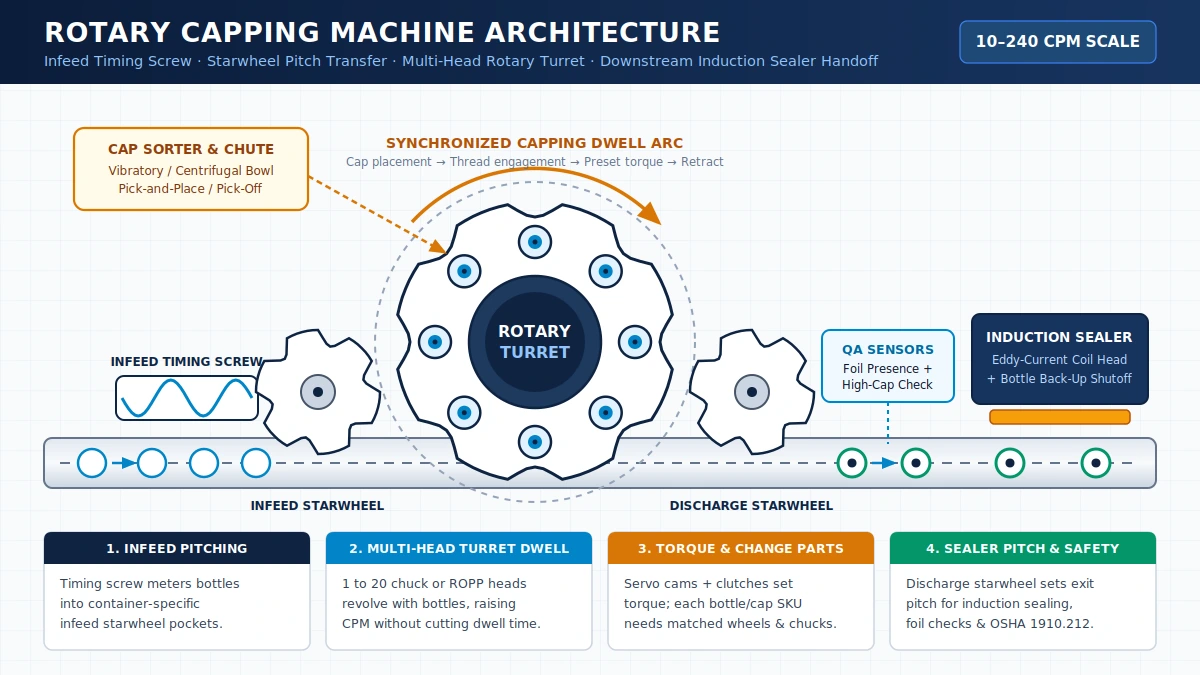
A rotary capping machine transfers containers through a pocketed starwheel onto a revolving multi-head turret, scaling output from 10 to 240 containers per minute by adding capping stations without cutting individual cap seating dwell time. Bottling lines should step up from inline cappers when speed, smooth or child-resistant closures, unstable bottles, or ROPP shells outweigh starwheel changeover downtime.
What Is a Capper Machine, and How Does a Rotary Capping Machine Work?
Every bottle capper machine executes a two-phase mechanical sequence consisting of cap placement followed by cap sealing. A rotary capping machine performs both phases continuously in circular motion, using an infeed starwheel to load each bottle into a dedicated pocket beneath its own revolving capping head so tightening occurs over a smooth circular dwell arc.
Instead of halting containers one by one under a single inline station or relying on side friction discs along a straight belt, a rotary turret carries bottles and capping heads together around a central column. Adding stations—from single-head and four-head rotary builds up to twelve-head glass-bottle turrets and 20-station AC chuck turrets—multiplies containers per minute while preserving full vertical stroke and controlled torque engagement on every closure. For a broader taxonomy of inline, chuck, snap, and metal-shell closing principles, see the capping machines guide.
Cap Placement: Pick-Off Chutes vs. Pick-and-Place Arms
Automated lines orient bulk closures using vibratory sorters, centrifugal sorters, or bulk elevator sorters selected by required speed and cap geometry. Once oriented, closures reach the bottle finish through one of two placement architectures:
- Pick-off chute delivery: A precision chute dispenses oriented closures so passing bottles pick off each cap on the fly. Pick-off delivery is widely used on straight-line cappers and on selected rotary builds running skirted or aluminum shells.
- Pick-and-place arm transfer: A mechanical or robotic-style transfer arm presents each closure directly into the capping chuck, which grips, seats, and tightens the closure onto the container. Pick-and-place handles a broader range of closure shapes and profiles, though it adds automation complexity and per-size tooling.
Turret Pitch, Dwell Time, and Anti-Rotation Controls
Container transfer depends on pocketed starwheels—large gear-like plastic wheels whose cutouts locate each bottle directly beneath a capping station—paired with adjustable stainless-steel and polyethylene outer guides and single-motorized inlet and outlet conveyors. On servo-driven rotary chuck frames such as the Accutek Servo Rotary Chuck Capper, servo motors, hybrid stepper drives, and an electronic adjustable cam driving precision ball screws replace physical mechanical cam tracks while executing two programmable vertical speeds for rapid approach and controlled closing across containers from two ounces to one gallon.
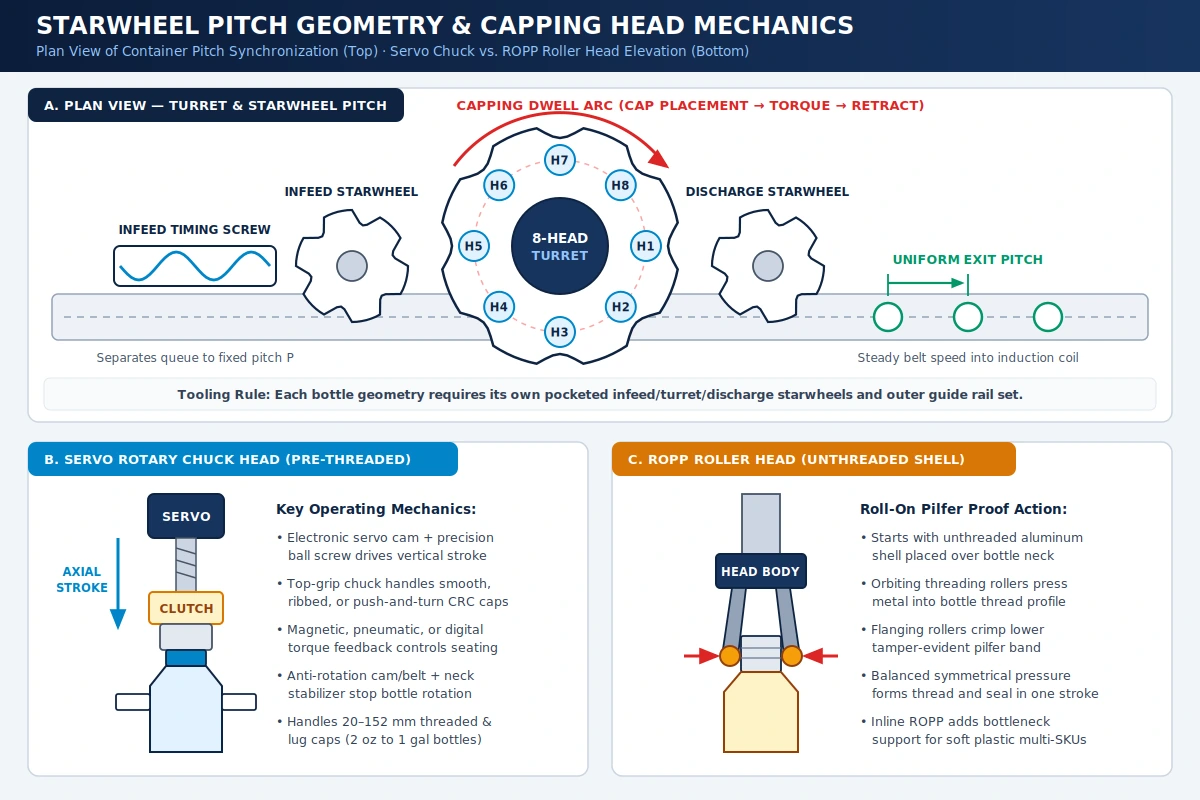
To keep containers from spinning during high-torque seating, industrial rotary turrets combine starwheel pocket support with cam- or belt-operated anti-rotation assemblies for round bottles, adjustable pneumatic grippers, and optional neck stabilizers for weak-walled containers. Torque itself is governed through magnetic clutches, pneumatic clutches, or optional digital torque feedback that monitors and adjusts application torque in real time.
What Is the Purpose of a Cap Sealing Machine vs. a Rotary Capper?
A rotary capping machine applies mechanical torque or rolls metal threads to fasten a closure onto a container neck, whereas a cap sealing machine performs non-contact electromagnetic induction sealing after filling and capping to weld a conductive foil innerseal hermetically to the bottle rim. Both machines serve distinct sequential roles on lined-closure bottling lines.
During induction cap sealing, the already-capped bottle travels beneath an energized induction coil head. Induced eddy currents heat the conductive aluminum foil layer inside the closure liner, melting the wax layer so it absorbs into the pulp backing and releases the foil from the cap while heating the bottom polymer film so it flows onto the container lip. Once cooled, the solidified polymer forms a hermetic bond on plastic or glass finishes. On retail over-the-counter human drug packaging accessible to the public—excluding dermatological, dentifrice, insulin, and lozenge products—this innerseal supports mandatory tamper-evident packaging compliance under 21 CFR 211.132. Explore sealing-head sizing, cooling utilities, and line qualification on the induction sealing machines hub.
Rotary vs. Inline Capping Machine: When Should a Bottling Line Step Up?
A bottling line should step up from an inline capper to a rotary capping machine when target throughput exceeds single-head inline pace, when closures have smooth sidewalls or downward push-and-turn child-resistant action, or when narrow and handled bottles destabilize between straight gripper belts—provided SKU runs are long enough to justify starwheel and chuck changeovers.
Inline machines excel on high-mix, multi-SKU lines running standard ribbed screw caps where rapid tool-free guide adjustments outweigh peak line speed; for friction-disc setup and clutch maintenance details, review the spindle capper guide. High-speed rotary turrets invert that trade-off by dedicating fixed pocketed tooling and multiple stations to sustained throughput.
| Machine Class | Capping Mechanism & Stations | Rated Speed & Cap Diameter | Container & Closure Fit | Utilities, Floor Mass & Rigging | Changeover & TCO Profile |
|---|---|---|---|---|---|
| Inline spindle capper | Continuous side friction discs with straight gripper belts | Matches moderate-to-fast inline fillers on standard continuous-thread closures | Practical choice for standard ribbed screw-on caps; unreliable on smooth walls or downward press-and-turn CRCs | Compact inline frame positioned over existing conveyor | Fast mechanical guide adjustment; no per-bottle starwheel swap |
| Inline chuck or inline ROPP capper | Single or indexing inline head; inline ROPP adds bottleneck support | Lower output than multi-head turrets; sized to match inline filler pace | Handles varied bottle shapes and soft plastic bottles (inline ROPP) without component swaps | Straight-line conveyor footprint | No bottle-specific starwheel swaps; chuck insert swap required per cap size |
| Small rotary chuck capper (single-head to four-head) | Pocketed starwheel + servo/chuck turret (e.g., Accutek Servo Rotary, Paxiom KAPR) | 10 to 100 CPM (up to 150 CPM across modular KAPR frames); 20 to 100 mm caps | Two ounces to one gallon; vials, tubes, wine bottles, cleaning goods, handled motor-oil and water jugs; threaded, TE, and CRC | 220V single-phase; ~71.5 in. (181.61 cm) L x 40 in. (101.6 cm) W x ~92.25 in. (234.32 cm) H; no caster wheels (forklift required) | Requires one starwheel per bottle geometry and matched chuck per cap size |
| High-speed multi-head rotary turret (twelve to 20 heads) | Multi-station rotary turret (e.g., twelve-head glass turret; Biner Ellison RC40 / RC52 up to 20 AC stations) | RC40 up to 140 CPM; RC52 up to 240 CPM; 0.98 to 5.98 in. (25 to 152 mm) screw and lug caps | Long production runs on glass and rigid plastic bottles with magnetic/pneumatic clutches and optional vacuum or toothed chucks | 90 PSI at 3 CFM air; 220/240 VAC, 20 AMP, 3-phase; 89 in. (226.06 cm) H x 54–62 in. L x 61–73 in. W; 2,350 lbs. (1,065.94 kg) | Full starwheel, guide, and multi-head chuck swaps offset by up to 99 saved job recipes |
Closure Geometry, Filler Pace, and Changeover TCO
Three engineering gates settle the inline-versus-rotary decision before equipment quotes are requested:
- Closure exterior and opening class: Side-disc spindle cappers lose grip on smooth-walled closures and cannot apply the downward axial load required by push-and-turn child-resistant closures classified by opening motion, skill, or tool under ASTM D3475-20. Top-grip rotary chucks solve both constraints cleanly.
- Matching upstream filler output: On an integrated bottle filling and capping machine line, rated capper speed must at least match the filler. If an upstream liquid filler delivers 60 containers per minute, any capper unable to sustain 60 containers per minute immediately bottlenecks the entire line. See full upstream conveyor accumulation logic in the filling, capping, and labeling line integration guide.
- Changeover downtime in total cost of ownership: Every plastic starwheel accommodates only one container geometry, and chuck heads require dedicated chuck tooling for each cap diameter. Plants running frequent short batches across dozens of bottle sizes often lose more daily output to starwheel, guide-rail, and chuck changeovers than a multi-head turret gains at top speed.
When Does a Small Rotary Capping Machine Make Sense?
A small rotary capping machine—configured with a single-head or four-head starwheel turret running 10 to 100 containers per minute—makes sense when container geometry or base instability defeats straight-line gripper belts even though line throughput does not demand a twelve- or 20-head high-speed turret.
Container physics, not raw speed alone, justifies compact rotary frames across four recurring packaging scenarios:
- Narrow vials and tubes: Small-diameter vials and cylindrical tubes tip easily along open straight belts; pocketed starwheels capture each container around its circumference and hold it upright directly beneath the chuck.
- Asymmetric handled jugs: Four-head rotary starwheel builds excel on motor oil jugs with handles and handled water jugs whose off-center geometry jams or twists between flat inline side belts.
- Specialty single-head bottle lines: Single-head rotary starwheel machines serve dedicated wine-bottle and household cleaning-goods lines where controlled pocket transfer improves cap alignment without high-speed multi-head capital.
- Wide-range servo flexibility: Compact servo rotary chuck frames span two-ounce bottles up to one-gallon containers and 20 mm to 100 mm threaded, tamper-evident, and child-resistant caps using programmable electronic cams and a 10-inch color touchscreen rather than mechanical cam swaps.
How Does a Rotary ROPP Capping Machine Differ from a Rotary Chuck Capper?
A rotary chuck capper grips a pre-threaded plastic or metal closure from above and rotates it to a preset torque, whereas a ropp capping machine places an unthreaded aluminum shell over the bottle neck and orbits threading and flanging rollers around the shell under balanced symmetrical pressure to form threads and crimp the tamper-evident pilfer band in one stroke.
Roll-On Pilfer Proof (ROPP) closing changes both head mechanics and bottle-wall requirements compared with pre-threaded screw chuck capping:
| Engineering Dimension | Rotary Chuck Capper | Rotary ROPP Capping Machine | Inline ROPP Capping Machine |
|---|---|---|---|
| Incoming closure blank | Pre-threaded screw, lug, tamper-evident, or child-resistant cap | Unthreaded aluminum shell placed over bottle neck | Unthreaded aluminum shell placed over bottle neck |
| Head closing mechanism | Top-grip chuck (standard, vacuum, or toothed) rotates cap to clutch or digital torque target | Descending roller head orbits threading rollers and flanging rollers around shell | Inline roller head forms threads and crimps pilfer band sequentially |
| Thread & tamper action | Engages existing cap threads; tamper band locks mechanically or via downstream induction liner | Forms bottle-matched threads and crimps lower tamper-evident pilfer band simultaneously under symmetrical pressure | Forms bottle-matched threads and crimps pilfer band simultaneously |
| Soft plastic bottle handling | Optional neck stabilizer and pneumatic grippers support weak-walled containers | Requires bottle-specific starwheel pockets and controlled vertical top load | Incorporates bottleneck supporting structure to prevent damaging soft plastic bottles |
| Multi-SKU changeover fit | Requires bottle starwheel and cap chuck insert swaps | Requires bottle-specific starwheels and roller setup | Handles varied bottle shapes without swapping bottle-change components |
Because ROPP rollers deform aluminum directly against the container finish under symmetrical inward pressure, rigid glass bottles pair naturally with high-speed rotary ROPP turrets, whereas multi-format lines running deformable soft plastic bottles often favor inline ROPP builds with dedicated bottleneck support.
What Engineering Factors Drive Rotary Capping Machine Price and Total Cost of Ownership?
Rotary capping machine investment and lifecycle operating cost are governed by six engineering specifications rather than nameplate speed alone: turret station count, servo-versus-AC drive and torque-control architecture, cap sorting hardware, SKU change-part tooling inventory, washdown guarding with fixed floor anchoring, and PLC recipe automation.
- Turret station count and frame size: Scaling from a single-head or four-head rotary frame (10 to 100 CPM) to a twelve-head glass turret or an RC40 (up to 140 CPM) and RC52 (up to 240 CPM) turret carrying up to 20 AC chuck stations multiplies heads, spindles, and frame mass—reaching 2,350 lbs. (1,065.94 kg) on heavy multi-station platforms.
- Drive, cam, and torque feedback architecture: Entry rotary turrets use AC drives paired with magnetic or pneumatic clutches, whereas servo rotary chuck frames add servo motors, hybrid stepper drives, precision ball screws, electronic adjustable cams, programmable two-speed vertical strokes, and optional go-no-go or digital torque feedback reporting.
- Cap orientation and delivery hardware: Selecting between vibratory bowls, centrifugal sorters, bulk elevator orientators, pick-off chutes, and automated pick-and-place arms scales directly with closure shape and line speed.
- SKU change parts and recipe recall: Budget a complete physical change-part set—infeed, turret, and discharge starwheels, outer guides, custom chucks (including vacuum or toothed inserts), neck stabilizers, and anti-rotation cam or belt kits—for every bottle and cap combination. Touchscreen PLC memory storing up to 99 job recipes speeds electronic setup while still requiring physical starwheel swaps.
- Washdown construction and machine guarding: Food, chemical, and pharmaceutical lines commonly specify 304 stainless-steel frames, stainless control enclosures, Mitsubishi PLC and SMC pneumatic packages, Perspex cladding with infeed and outfeed tunnels, and interlocked easy-open inspection doors with mechanical safety switches to satisfy machine-guarding requirements protecting operators from point-of-operation hazards, ingoing nip points, and rotating parts under OSHA 1910.212(a)(1).
- Rigging, utilities, and floor anchoring: Unlike wheeled inline frames, rotary cappers ship without casters and require forklift rigging, dedicated 220V single-phase or 220/240 VAC 20 AMP 3-phase power plus 90 PSI at 3 CFM compressed air on larger models, and secure floor anchoring under OSHA 1910.212(b) to prevent fixed machinery from walking or moving.
How Should a Rotary Capper Hand Off Pitch, Inspection, and Torque Audits to an Induction Sealer?
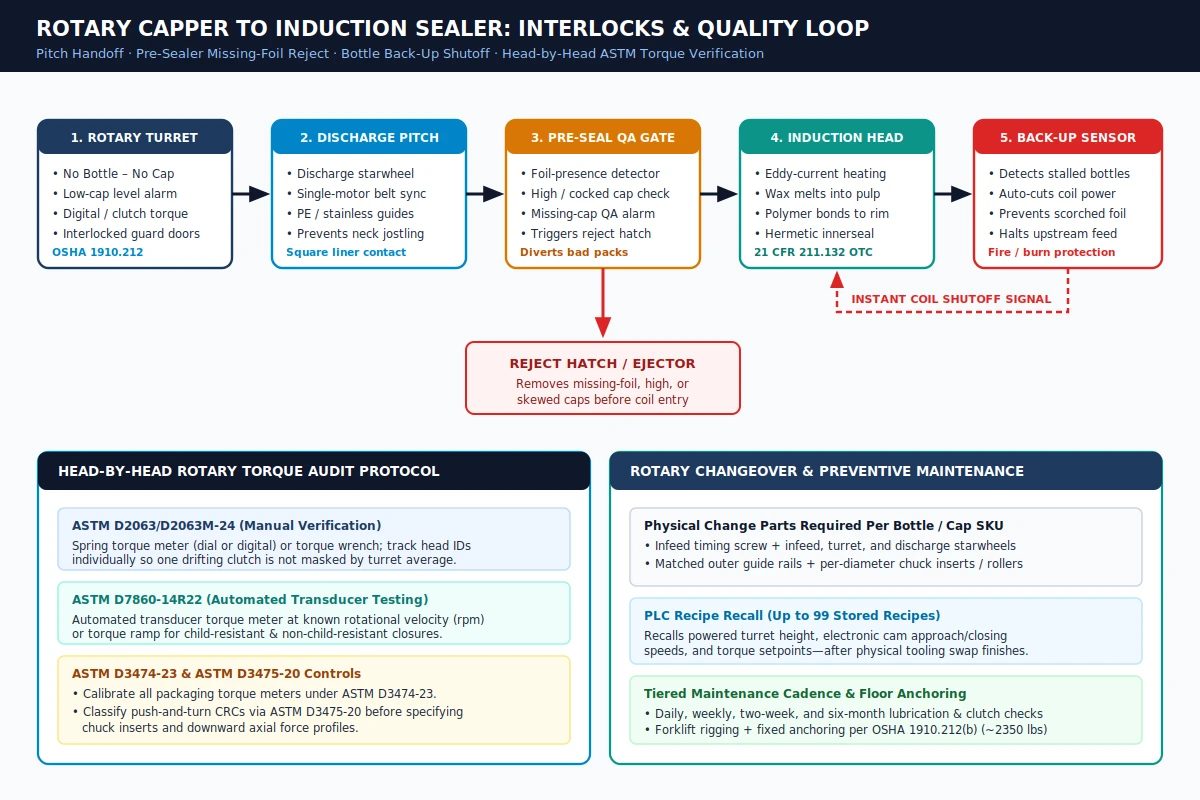
A rotary capper feeding an induction sealer maintains uniform discharge pitch via single-motorized conveyor synchronization, rejects unlined or cocked caps before coil entry using missing-foil and QA alarms, interlocks downstream bottle back-up sensors to shut off coil power automatically if bottles stall, and verifies closure torque head by head under active ASTM standards.
Conveyor Pitch, Missing-Foil Rejection, and Bottle Back-Up Shutoff
Discharge starwheels hand bottles onto the outfeed conveyor at clean, repeatable spacing—a natural advantage for downstream induction heating when paired with single-motor inlet and outlet conveyor drives and stainless or polyethylene side guides. Four automated interlocks belong between the rotary turret and the sealing coil, detailed further in the capping and induction sealing line integration guide:
- No Bottle – No Cap and low-cap alarms: Prevents empty starwheel pockets from dropping loose closures onto the conveyor and alerts operators before hopper starvation causes uncapped bottles.
- High, skewed, and missing-cap QA sensors: Flags tilted or unseated caps immediately downstream of the discharge starwheel before uneven foil-to-coil clearance produces cold or scorched seals.
- Pre-sealer missing-foil reject hatch or ejector: Verifies conductive aluminum foil presence inside each closed cap and triggers an automated reject hatch or pneumatic ejector to remove unlined containers before they reach the sealing zone.
- Downstream bottle back-up coil shutoff: Detects containers accumulating beneath the induction head and shuts off the induction sealer automatically. Without back-up shutoff protection, stationary foil liners overheat rapidly and can burn, damaging both packaged product and the sealing system.
Head-by-Head ASTM Torque Verification and Preventive Maintenance
Because a multi-head rotary turret masks one drifting clutch inside a line-wide average, quality technicians must number capping heads and sample containers from every station individually. Govern line verification with three active ASTM packaging standards (see instrument sizing in the bottle cap torque tester guide):
- Manual verification (ASTM D2063/D2063M-24): Measures torque retention on continuous-thread closures using a non-automated spring torque meter with a dial indicator or digital readout, or a torque wrench.
- Automated testing (ASTM D7860-14(2022)): Measures torque retention on child-resistant and non-child-resistant continuous-thread packages using an automated transducer-based torque meter operating at a known rotational velocity (rpm) or torque ramp.
- Meter calibration (ASTM D3474-23): Establishes standard calibration and operating practices for packaging torque meters so station-to-station comparisons stay valid across shifts.
Pair head-by-head torque logging with a four-tier preventive maintenance schedule—executing documented machine checks every day, every week, every two weeks, and every six months—to catch clutch wear, guide-rail looseness, and starwheel pocket abrasion before misalignment reaches the induction head.
Rotary vs. Inline Capping Machine Line Selection Checklist
Use this engineering checklist when evaluating a rotary capping machine against inline alternatives and planning commissioning ahead of an induction sealer:
| Evaluation Gate | Required Line Specification | Pass Criterion Before Purchase / Release | Status |
|---|---|---|---|
| Throughput & filler match | Upstream filler rate (e.g., 60 containers per minute baseline vs. 100 to 240 CPM target) | Capper rated speed equals or exceeds peak filler output without bottlenecking | [ ] |
| Closure & container fit | Screw and lug cap diameter (20 mm to 100 mm or 25 mm to 152 mm), smooth/CRC/ROPP geometry, bottle stability | Confirm chuck vs. ROPP roller head, ASTM D3475-20 CRC class, and neck-stabilizer or anti-rotation needs | [ ] |
| Changeover TCO audit | Active bottle SKU count, starwheel and chuck change-part sets, recipe count (up to 99) | Verify total starwheel/chuck swap downtime stays below throughput gained over inline capping | [ ] |
| Floor rigging & utilities | Forklift access, floor anchoring, 220V single-phase or 220/240 VAC 20 AMP 3-phase, 90 PSI at 3 CFM air | Confirm footprint, 2,350 lbs. slab load where applicable, and OSHA 1910.212 guarding and anchoring | [ ] |
| Induction sealer interlocks | Single-motor belt sync, No Bottle – No Cap, missing-foil reject, bottle back-up shutoff | Challenge reject hatch and verify automatic coil shutoff on stalled bottles before batch release | [ ] |
| Head-by-head torque QC | Station-labeled samples tested on ASTM D3474-23 calibrated meters | Pass ASTM D2063/D2063M-24 or ASTM D7860-14(2022) retention checks across all turret heads and log daily/weekly/two-week/six-month PM | [ ] |
Frequently Asked Questions
When does a bottling line need a rotary capping machine instead of an inline capper?
A bottling line needs a rotary capping machine when sustained speed up to 140 to 240 CPM, smooth-sided or push-and-turn child-resistant closures, tall or handled bottles, or aluminum ROPP shells exceed inline capabilities—and changeover frequency stays low enough that starwheel and chuck swaps do not erase throughput gains.
What is the difference between a bottle capping machine and a cap sealing machine?
A bottle capping machine executes mechanical cap placement and closure tightening or ROPP thread rolling, whereas a cap sealing machine applies non-contact electromagnetic induction heating after capping to melt foil-liner wax into pulp backing and bond the polymer seal layer hermetically onto the bottle lip.
When does a small single-head or four-head rotary capping machine make sense?
Compact single-head and four-head rotary starwheel cappers running 10 to 100 CPM fit narrow or unstable vials, tubes, wine bottles, cleaning goods, and asymmetric handled motor-oil or water jugs whose bases tip or twist between straight inline side gripper belts.
What separates a rotary ROPP capper from a rotary chuck capping machine?
A rotary chuck capper grips and twists a pre-threaded plastic or metal closure to preset torque, whereas an ROPP capping machine drops an unthreaded aluminum shell onto the neck and orbits threading and flanging rollers under balanced symmetrical pressure to form threads and crimp the pilfer band simultaneously.
Why do frequent bottle changeovers hurt rotary capping machine total cost of ownership?
Each starwheel pocket fits only one container profile and each chuck insert fits one cap size, so high-mix short-run lines face recurring hardware swap downtime and change-part tooling inventory costs that must be weighed alongside initial machine capital.
Primary Sources & Referenced Standards
- ASTM D2063/D2063M-24: Standard Test Methods for Measurement of Torque Retention for Packages with Continuous Thread Closures Using Non-Automated (Manual) Torque Testing Equipment — ASTM International
- ASTM D7860-14(2022): Standard Test Methods for Measurement of Torque Retention for Child Resistant and Non-Child Resistant Packages with Continuous Thread Closures Using Automated Torque Testing Equipment — ASTM International
- ASTM D3474-23: Standard Practice for Calibration and Use of Torque Meters Used in Packaging Applications — ASTM International
- ASTM D3475-20: Standard Classification of Child-Resistant Packages — ASTM International
- 21 CFR 211.132: Tamper-evident packaging requirements for over-the-counter (OTC) human drug products — Electronic Code of Federal Regulations
- OSHA 1910.212: General requirements for all machines — Occupational Safety and Health Administration
- Induction sealing — Wikipedia
More about Induction Sealing Machines
Electromagnetic induction cap sealers, flat vs. tunnel sealing coils, kW power-to-line-speed matching, capping head integration, and troubleshooting.
Related Articles
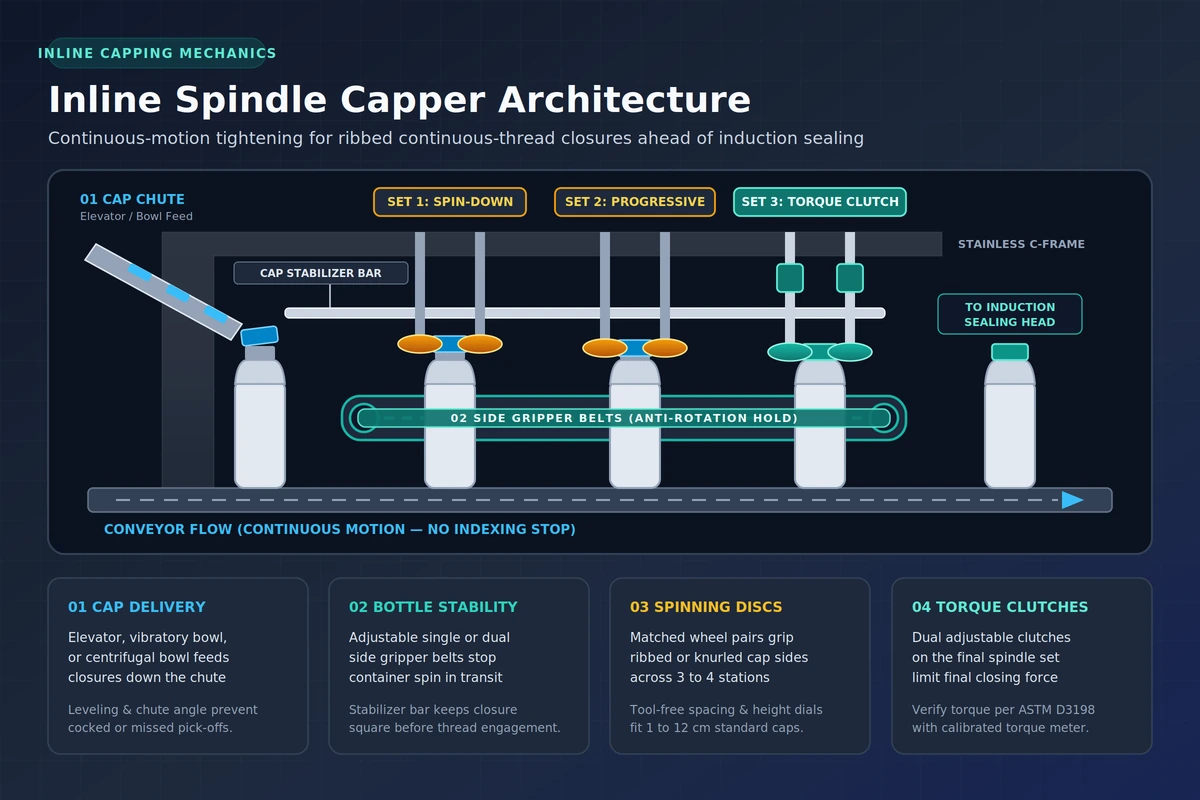
Spindle Capper: How It Works, Torque Clutch & Setup
Inline spindle cappers tighten continuous-thread caps in motion with side gripper belts, spinning discs, and clutches—setup, drift, and retorquers.

Induction Coil Air Gap and Foil Distance: Centering and Height Setup
Set up an induction sealing air gap: compare measurement references, check head centering and height, and prepare a product changeover record.
Hot-Fill vs Cold-Fill Induction Sealing: Foil Heating Window and Headspace Pressure
Compare hot-fill and cold-fill induction sealing, then qualify the heating window, neck fit and cooled-pack integrity before transferring a line recipe.