
Pressure Sensitive Liner: Bonding vs Heat Seals
A pressure sensitive liner bonds dry container mouths via cap torque and a 48-hour cure, while heat-induction foil seals block liquids, oxygen, and tampering.
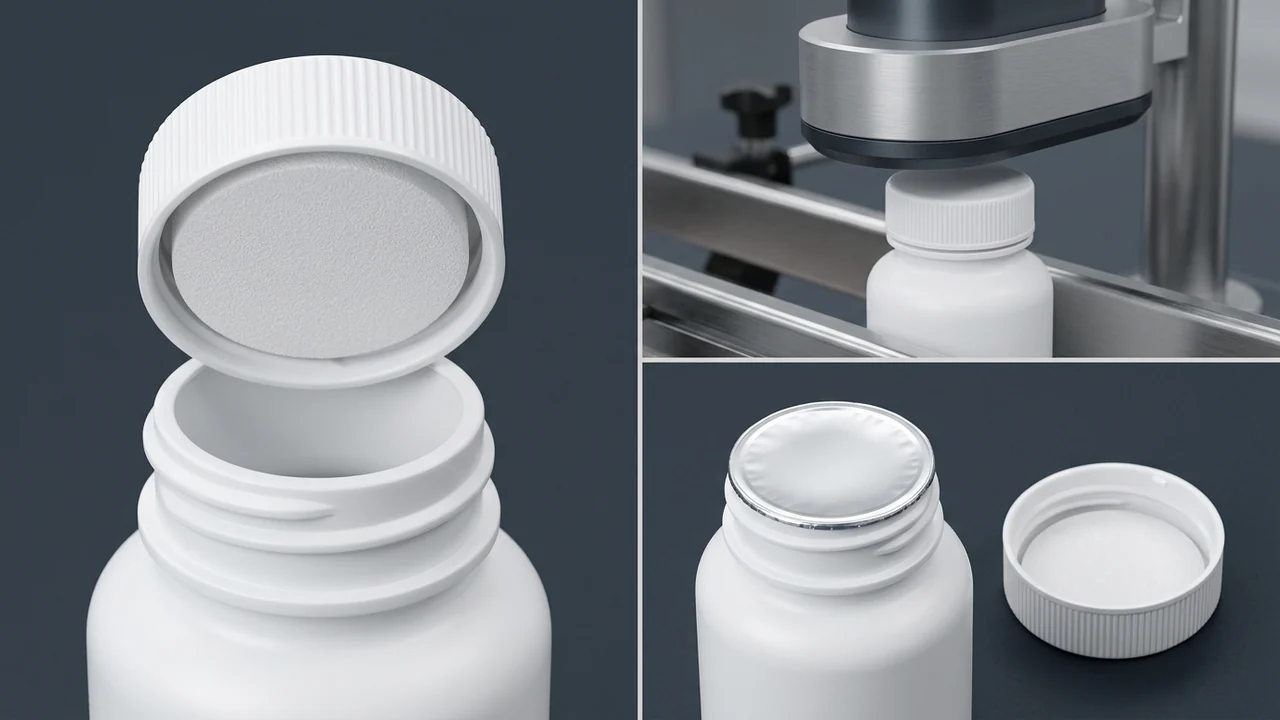
A pressure sensitive liner is a polystyrene foam disc coated on its underside with tiny sealed adhesive bubbles that burst under screw-cap torque to bond onto a clean, dry container lip without heat, water, or solvents. After at least 48 hours of dwell, it holds dry solids, while heat-induction foil liners seal liquids.
Within a structured cap liner selection program, engineering teams evaluate initial leakage protection, visible opening evidence, removal behavior, and repeated-closure resealing as separate specifications. Teams matching container resins to foil membranes can review the induction sealing liners guide alongside the compatibility, regulatory, torque, and storage boundaries below.
What Is a Bottle Cap Liner and What Jobs Does It Perform?
A bottle cap liner, also called a cap seal, is a thin film of aluminium, plastic, foam, pulp, or compound materials positioned across the opening of vials, bottles, jars, pill bottles, or jugs to stop leaks, block light, oxygen, moisture, germs, and odours, or show first-opening evidence.
Depending on how the disc is constructed, closure liners separate by sealing function rather than acting as interchangeable gaskets. An electromagnetic induction innerseal bonds a conductive foil and polymer membrane directly to the container mouth after filling and capping to form a hermetic seal. A pressure-sensitive liner relies on adhesive contact under closure pressure without induction heating and is recommended only for dry products. A primary polyethylene (PE) foam or pulp liner stays inside the cap and seals through mechanical compression between the closure and container finish.
How Does a Pressure Sensitive Liner Compare to a PE Foam Liner?
A primary PE foam or pulp liner is a non-adhesive compression gasket that stays inside the closure across repeated openings, whereas a pressure sensitive liner uses torque-activated adhesive to transfer its polystyrene foam disc onto the bottle lip as a single-use cover recommended for dry products without induction heating.
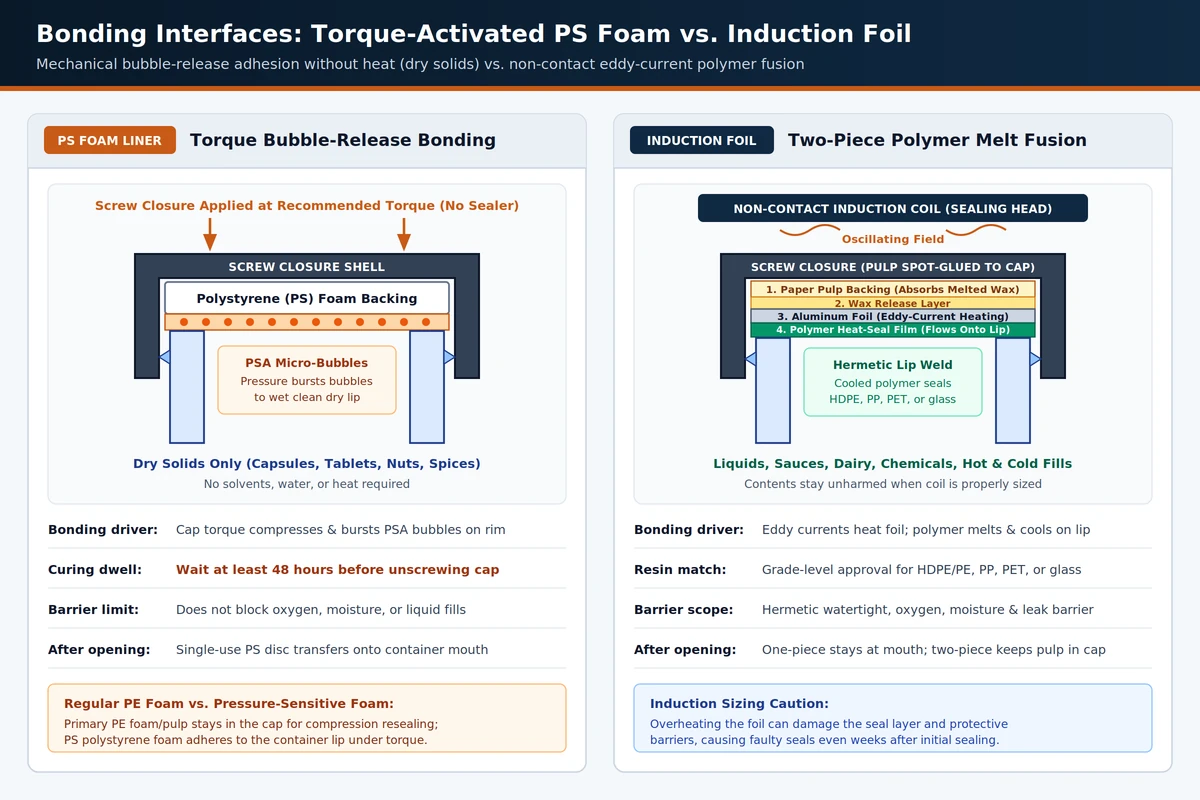
As packaging distributor Aaron Packaging describes, the active underside of a pressure-sensitive (PS) liner carries tiny, sealed bubbles of adhesive; screwing the cap down compresses the liner against the bottle neck and bursts those bubbles to release the adhesive onto the lip. Under pressure-sensitive adhesive physics, a self-stick adhesive forms its bond under light pressure without solvents, water, or heat because the elastomer is soft enough to flow and wet the adherend while remaining firm enough to resist flow under stress.
By contrast, a regular primary PE foam or pulp liner carries no bottle-facing adhesive, so it remains seated inside the screw closure to provide a compression reseal when the consumer reapplies the cap. Neither foam option substitutes for a multi-layered two-piece foil seal liner when a product needs both a hermetic innerseal and a cap-retained resealing liner. In a typical multi-layered induction liner, a top paper pulp layer is spot-glued into the cap above a wax layer, conductive aluminum foil, and a bottom polymer film; eddy currents induced under an oscillating electromagnetic coil melt the wax into the pulp backing to release the foil while the heated polymer film flows onto the container lip and cools into a hermetic bond. For dedicated separation-layer engineering, see the one-piece vs two-piece induction liner comparison.
| Closure Liner Construction | Sealing Activation Mechanism | Location After First Opening | Repeated Resealing Role | Recommended Product Scope |
|---|---|---|---|---|
| Pressure-sensitive (PS) polystyrene foam liner | Cap torque bursts underside adhesive bubbles onto rim without heat | Adheres to container mouth until peeled away | Single-use mouth cover; no cap-retained compression gasket | Dry products only (capsules, tablets, spices, powder mixes, nuts) |
| Primary PE foam or pulp liner | Mechanical compression between closure and container land | Remains seated inside the screw closure | Provides compression resealing when cap is reapplied | Closure-fit compression sealing; repeated-use leakage control |
| One-piece heat-induction foil liner | Non-contact electromagnetic eddy currents melt bottom polymer film | Entire foil innerseal remains bonded at the bottle mouth | Removed at opening unless paired with a separate cap feature | Hermetic liquid, barrier, food, chemical, and pharmaceutical packs |
| Two-piece heat-induction foil liner | Induction heat melts wax into pulp backing and fuses polymer to lip | Foil innerseal bonds to mouth; pulp backing stays in cap | Cap-retained pulp backing cushions reclosure after foil removal | Hermetic liquid, barrier, hot-fill, refrigerated, and OTC packs |
Pressure Sensitive Cap Seals vs Heat Seals: Which Fits Your Product?
Pressure-sensitive cap seals fit dry capsules, tablets, spices, spice seasonings, powder mixes, and nuts when no sealing machine is used, whereas heat seals applied by conduction or induction are required for spreads, sauces, honey, dairy, toothpaste, inks, liquid chemicals, hot-packed or refrigerated fills, moisture or oxygen barriers, and customized seals.
Packaging supplier Fidel Fillaud distinguishes the two families by both physical state and thermal exposure. Heat-applied seal liners consist of a plastic, aluminium, or paper film paired with a heat-seal layer fused to a compatible container lip by conduction or induction sealing, and only heat seals can be supplied flat or pre-formed with customized brand or security printing. Whenever a seal contacts foodstuffs, packagers must verify material compatibility against technical and regulatory specifications for that food type.
Aaron Packaging highlights two further material boundaries on polystyrene PS foam liners: they cannot block moisture and oxygen flow into hygroscopic contents, and polystyrene foam is not accepted as a recycled material at most municipal recycling programs. On liquid and industrial lines, flat induction sealing heads prevent leaks and extend food and beverage shelf life, and some freight carriers require liquid chemical containers to be hermetically sealed prior to shipping so hazardous chemicals cannot spill onto other cargo. When specifying a heat seal liner, request a supplier grade approved for the exact HDPE or other PE, PP, PET, or glass finish and formulation, and size the induction sealing system properly—overheating the foil can damage the seal layer and protective barriers, causing faulty seals weeks after initial production.
| Selection Criterion | Pressure-Sensitive (PS) Polystyrene Liner | Heat-Seal / Foil Induction Liner |
|---|---|---|
| Sealing machinery required | None; activated by screw closure torque | Conduction heat sealer or non-contact electromagnetic induction sealer |
| Dry supplements, nuts & whole spices | Suitable for dry capsules, tablets, nuts, and dry spices | Suitable; adds oxygen, moisture, aroma, and tamper barriers |
| Liquids, sauces, spreads, honey & dairy | Not recommended; does not prevent liquid leakage | Recommended for spreads, sauces, honey, dairy, toothpaste, and inks |
| Liquid chemical freight | Unsuitable for liquid spill containment | Used where shipping carriers require sealed liquid chemicals before transit |
| Hot-filled or refrigerated products | Unsuitable; PS adhesive softens in heat and loses tack in cold | Required by Fidel Fillaud for both hot-packed and refrigerated products |
| Oxygen & moisture transmission | Does not seal against moisture or oxygen flow | Hermetic foil-polymer weld blocks oxygen, moisture, light, germs, and odours |
| Custom printing & municipality recycling | Cannot be custom printed; polystyrene is not recycled at most municipalities | Customizable flat or pre-formed seals; matched to PE, PP, PET, or glass rims |
Why Can Salt or Powder on Dry Rims Defeat Pressure Sensitive Liners?
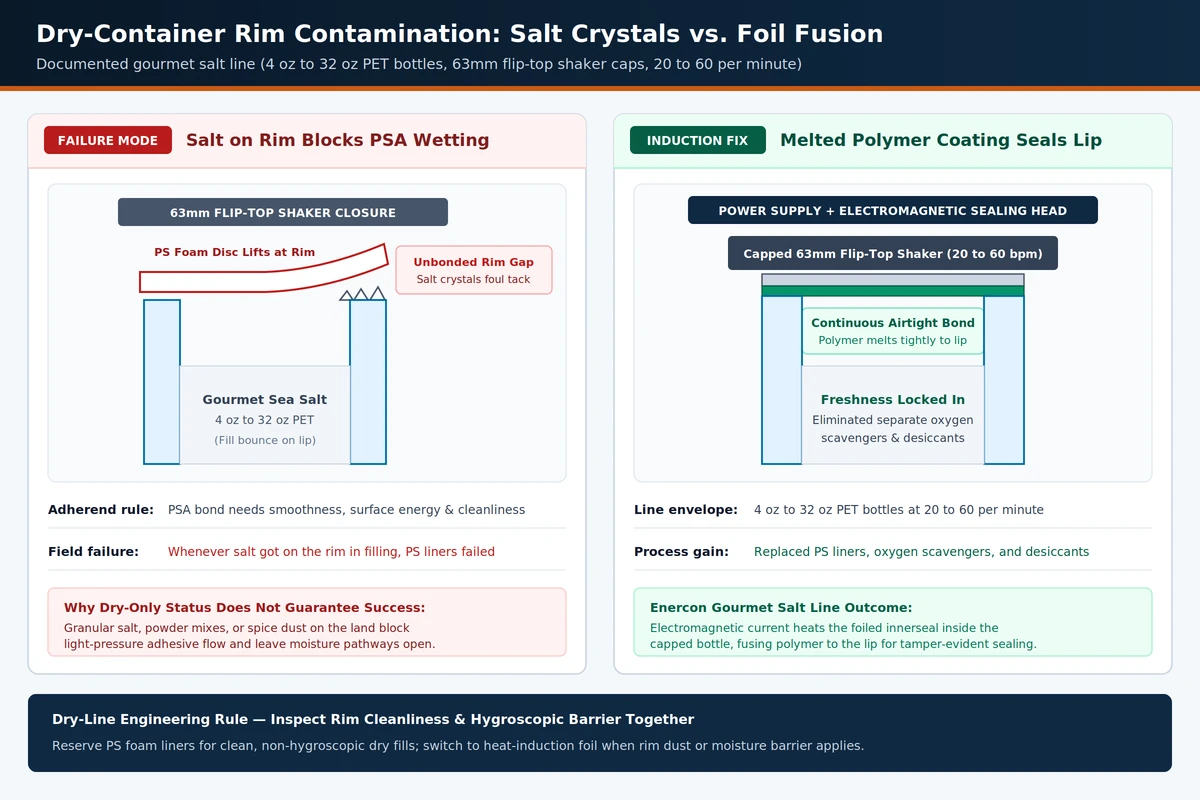
Even on dry containers, a pressure-sensitive adhesive bond depends directly on applied cap pressure plus bottle-rim smoothness, surface energy, and cleanliness, meaning stray salt crystals, spice dust, or powder granules landing on the container lip during filling prevent adhesive wetting and cause premature liner failure.
Because pressure-sensitive adhesives rely on light pressure to flow across and wet the adherend surface, particulate contamination sitting on the sealing land creates physical standoffs that block molecular contact. A documented Enercon Industries gourmet salt packaging case illustrates how quickly dry-rim fouling defeats torque-activated foam discs in production. On a West Coast specialty salt line running 4 oz to 32 oz PET bottles outfitted with 63mm flip-top shaker caps at speeds between 20 and 60 containers per minute, the packager originally relied on pressure-sensitive liners. Whenever coarse or fine salt crystals landed on the bottle rim during filling, the pressure-sensitive liners failed to adhere.
Replacing the pressure-sensitive foam discs with electromagnetic induction cap sealing resolved both rim lift-off and moisture ingress. Passing the capped shaker bottles beneath an induction sealing head heated the foiled innerseal and melted its polymer coating so heat and cap pressure fused a tight, airtight bond onto the PET container lip, allowing the plant to eliminate separate oxygen scavengers and desiccants.
Are Pressure Sensitive Liners Tamper-Evident Under 21 CFR 211.132?
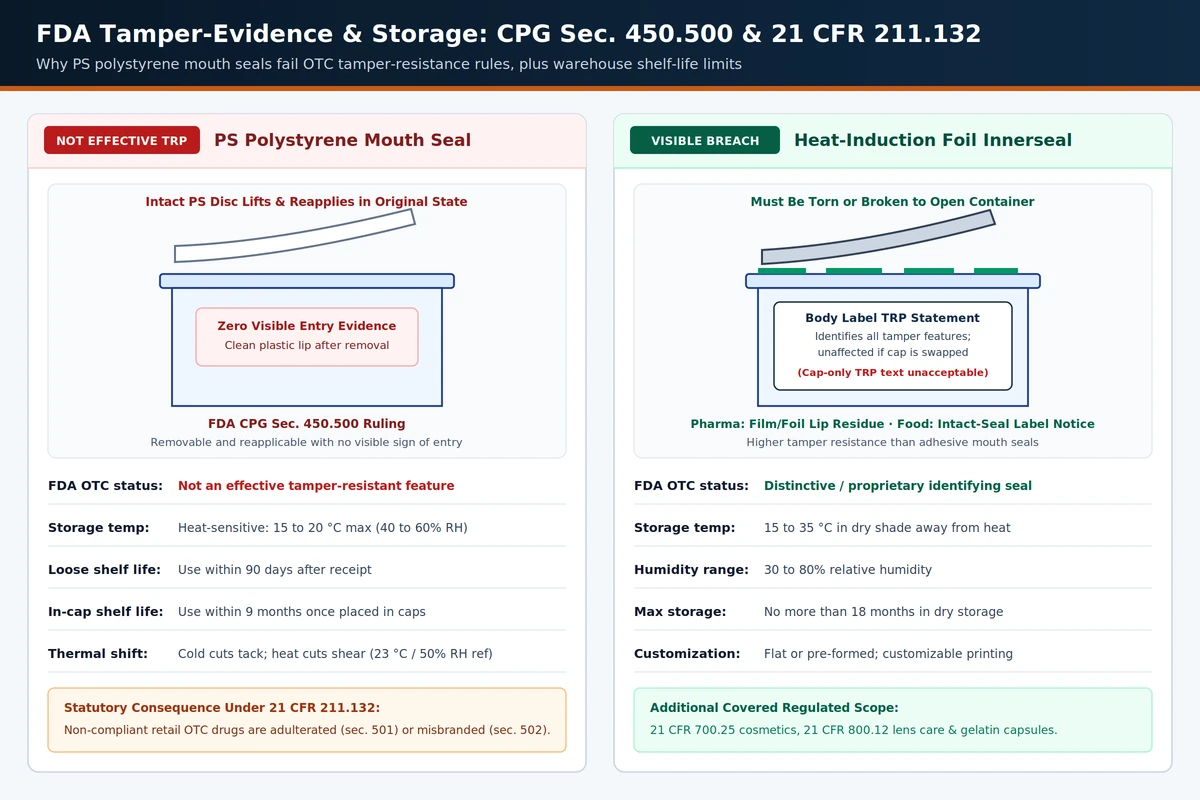
Under FDA’s tamper-resistant packaging Compliance Policy Guide and 21 CFR 211.132, polystyrene foam container mouth seals applied with pressure-sensitive adhesive are no longer considered effective tamper-resistant features because they can be removed and reapplied in their original state with no visible evidence of entry for consumers.
Federal tamper-resistant packaging (TRP) regulations mandate visible-entry packaging across three regulated retail product groups: over-the-counter (OTC) human drug products (except dermatologics, dentifrices, insulin, and throat lozenges) under 21 CFR 211.132, cosmetic liquid oral hygiene and vaginal products under 21 CFR 700.25, and contact lens solutions and tablets under 21 CFR 800.12. Under 21 CFR 211.132, any covered retail OTC drug product not packaged in a compliant tamper-resistant package or properly labeled is adulterated under section 501 of the Federal Food, Drug, and Cosmetic Act, misbranded under section 502, or both.
Distinctiveness, Capsule Sealing, and Cap-Independent Labeling Rules
To comply with 21 CFR 211.132 and FDA container-mouth innerseal guidance, regulated closures and inner seals must satisfy four structural and labeling rules:
- Tear-or-residue breach behavior: Qualifying container mouth inner seals made of paper, thermal plastic, plastic film, foil, or combinations sealed to the mouth under the cap must be torn or broken to open the container, and FDA notes that heat-induction seals on plastic containers offer a higher degree of tamper resistance than seals that depend on an adhesive bond.
- Distinctive or proprietary design: The tamper-evident barrier must remain intact during reasonable manufacture, distribution, and retail display, and must either be distinctive by design (impossible to duplicate with commonly available materials or processes) or carry an identifying characteristic such as a pattern, name, registered trademark, logo, or picture—with a proprietary characteristic different for each product size recommended by FDA.
- Hard gelatin capsule sealing and cap-independent statements: Under paragraph (b)(1) of 21 CFR 211.132, any covered two-piece hard gelatin capsule must also be sealed with an acceptable tamper-evident technology, and retail packages (except ammonia inhalants in crushable glass ampules or liquefied/compressed-gas aerosols) must carry a prominent statement identifying every tamper-evident feature placed where it stays unaffected if the feature is breached or missing—making cap-printed warning statements unacceptable whenever an unlabeled cap could easily be substituted.
- Pharmaceutical residue versus food clean-peel notices: Pharmaceutical companies purchase heat-induction liners engineered to leave noticeable liner film or foil residue on plastic bottle rims upon opening, whereas food packagers avoid rim residue that could interfere with dispensing and instead print a package notice advising consumers to check for an intact factory seal before use. Compare innerseals against external neck bands in our tamper-evident induction liners vs shrink bands guide.
What Torque, 48-Hour Dwell, and Storage Rules Prevent Seal Failure?
Reliable pressure-sensitive liner adhesion requires tightening screw closures strictly to their recommended application torque, waiting at least 48 hours of drying dwell before reopening any cap, and storing heat-sensitive liners between 15 and 20 °C at 40 to 60% relative humidity for no more than 90 days loose or 9 months in caps.
Delayed-permanent pressure-sensitive adhesives are initially removable right after application and build permanent bond strength over hours or days as adhesive viscosity and interfacial contact evolve. Fidel Fillaud warns packaging lines never to unscrew a freshly capped pressure-sensitive closure early—even to slip a promotional leaflet or dosing accessory between the seal and cap—until at least 48 hours have elapsed, and to hold cap tightening within the closure supplier’s torque specification (see our application torque window guide for capper torque controls).
Ambient and warehouse temperatures govern tack before and after capping. While standard PSA and tape test methods are referenced at 23 °C and 50% relative humidity, cool application or cold-chain conditions make a pressure-sensitive adhesive too firm—causing tack loss and premature release—whereas elevated heat softens the adhesive and reduces shear holding strength. Because pressure-sensitive polystyrene liners are heat-sensitive, Fidel Fillaud specifies tighter temperature, humidity, and inventory turnover limits than those allowed for heat-seal foil liners.
| Operational or Warehouse Parameter | Pressure-Sensitive (PS) Polystyrene Seals | Heat-Seal / Foil Induction Liners |
|---|---|---|
| Capping torque control | Strictly respect recommended closure torque to burst adhesive bubbles | Maintain consistent downward cap pressure to hold foil against lip |
| Minimum dwell before opening cap | At least 48 hours (including before leaflet insertion or seal checks) | Bonds upon polymer cooling after passing beneath the induction head |
| Warehouse storage temperature | 15 to 20 °C maximum (heat-sensitive adhesive) | 15 to 35 °C in a dry location away from sunlight and heat sources |
| Warehouse relative humidity | 40 to 60% relative humidity | 30 to 80% relative humidity |
| Loose liner maximum shelf life | Use within 90 days after receipt | Store for no more than 18 months to preserve seal quality |
| Pre-lined closure shelf life | Use within 9 months once liners are placed inside caps | Store for no more than 18 months away from direct heat sources |
Liner Selection and Warehouse Qualification Checklist
Verify every item below before releasing a pressure-sensitive foam liner or switching the container to an induction foil innerseal:
- Confirm the product is an ambient dry solid (capsules, tablets, nuts, or clean dry spices) requiring no liquid containment, oxygen barrier, moisture barrier, hot-fill survival, or refrigerated distribution.
- Audit filling-head dust and bounce to verify that salt crystals, powder mixes, or oil films do not contaminate the bottle lip before capping.
- Check regulatory scope under 21 CFR 211.132, 21 CFR 700.25, and 21 CFR 800.12; specify a distinctive tear-or-residue heat-induction innerseal and cap-independent label statement whenever tamper-evident compliance is required.
- Lock in closure application torque on the capper and quarantine capped pressure-sensitive lots for at least 48 hours before any destructive seal inspection or cap reopening.
- Enforce date-sequenced climate storage at 15 to 20 °C maximum and 40 to 60% relative humidity so loose PS discs are consumed within 90 days of receipt and pre-lined caps within 9 months.
Frequently Asked Questions
Can you use a pressure sensitive liner for liquids or oily products?
No. Pressure-sensitive polystyrene foam liners are recommended strictly for dry products such as capsules, tablets, spices, powder mixes, and nuts because they cannot hold back liquids, oils, moisture, or oxygen; spreads, sauces, honey, dairy, toothpaste, inks, and liquid chemicals require a resin-matched heat seal liner.
How long does a pressure sensitive cap liner take to adhere to a bottle?
Wait at least 48 hours after applying the screw cap at its recommended torque before unscrewing the closure, because delayed-permanent pressure-sensitive adhesives require hours to days of dwell time to wet the container rim and reach full bond strength.
Do pressure sensitive liners require an induction sealing machine?
No sealing machine, solvent, water, or heat is needed to apply a pressure-sensitive liner: tightening the screw cap compresses the polystyrene backing against the container neck and bursts tiny underside adhesive bubbles to bond the disc to a clean, dry lip.
Are polystyrene pressure sensitive liners recyclable or custom printable?
Polystyrene foam used in pressure-sensitive liners is not accepted for recycling at most municipalities, and Fidel Fillaud notes that only heat-applied seals—not pressure-sensitive foam seals—can be custom printed with brand logos or proprietary patterns.
How long can unused pressure sensitive liners be stored before capping?
Per Fidel Fillaud’s storage guidelines, heat-sensitive pressure-sensitive seals must be stored between 15 and 20 °C maximum at 40 to 60% relative humidity, used within 90 days after receipt when loose, and used within 9 months once seated inside closures—compared with up to 18 months at 15 to 35 °C and 30 to 80% humidity for heat seals.
Sources
- U.S. Food and Drug Administration (FDA) — Compliance Policy Guide: Tamper-Resistant Packaging Requirements for Certain Over-the-Counter Human Drug Products
- Electronic Code of Federal Regulations — 21 CFR § 211.132: Tamper-Evident Packaging Requirements for Over-the-Counter (OTC) Human Drug Products
- Wikipedia — Induction Sealing
- Wikipedia — Pressure-Sensitive Adhesive
- Enercon Industries — Induction Seal Replaces Pressure-Sensitive Liner for Airtight Seal
- Fidel Fillaud — Pressure Sensitive Cap Seals vs Heat Seals: Which to Choose and How to Store Them?
- Aaron Packaging — Pressure Sensitive Liners in the Container Packaging Industry
More about Cap & Liner Selection
One-piece and two-piece wax-backed or polymer-bonded foil innerseals, container resin compatibility (PE, PP, PET, PVC, glass), and ROPP vs. cork closures.
Related Articles
Vented vs Hermetic Induction Seal Liners Guide
Compare vented induction seal liners and hermetic induction liners: review off-gassing pressure behavior, ePTFE membrane specs, and leak-testing scope.
Induction Seal Application Torque Window: Liner Compression vs Coil Power
Set up your induction seal application torque trial with starting guidelines, removal-torque checks, contact inspection and a blank package record.
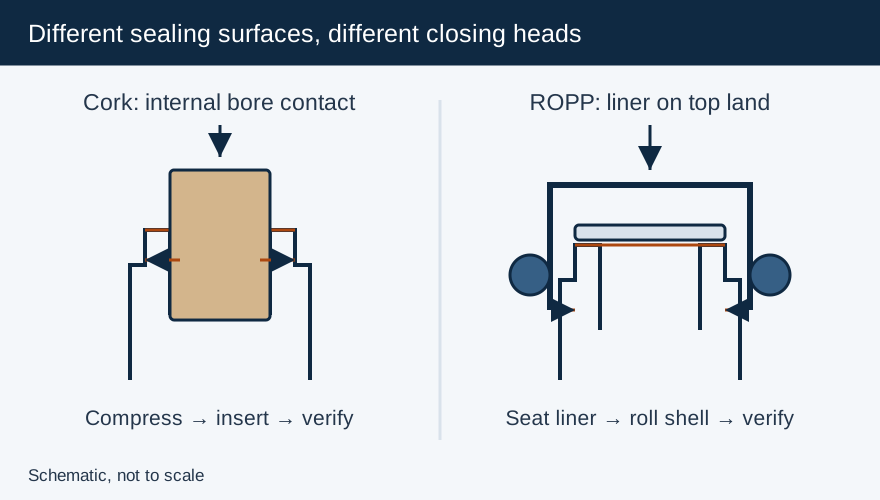
Cork vs Screw Cap: What Changes in the Bottling and Closing Process?
Compare still-wine cork insertion and ROPP screw capping by bottle finish, closing action, headspace control, liner and release tests.